
How to Control What ChatGPT Says About You Using Podcast Appearances and Five AI Search Optimization Factors
Article Description: AI search is now how your ideal clients research you before buying, and most business owners have zero control over what ChatGPT, Claude, and other LLMs say about them. This article breaks down the exact five factors that influence AI recommendations and how strategic podcast appearances give you control over all five.
Table of Contents:
Why AI Search Is Actively Screwing Business Owners Without Them Knowing
The Psychological Safety Problem: Why Trust Is the Currency That Converts
Pattern Density: How to Show Up More Often in AI Search Results
Source Credibility: Why Niche Podcasts Beat Massive Audiences for AI Visibility
Third Party Validation: How Podcast Appearances Build Trust Through Expert Endorsement
Specificity of Claims: Why Vague Promises Kill Your AI Search Presence
Consistency and Omnipresence: How to Make AI Form a Clear Picture of Who You Are
How Podcast Transcripts and Show Notes Get Indexed by AI Algorithms
The Five Factor Framework: Putting It All Together for AI Search Domination
How to Audit What AI Currently Says About You and Your Competitors
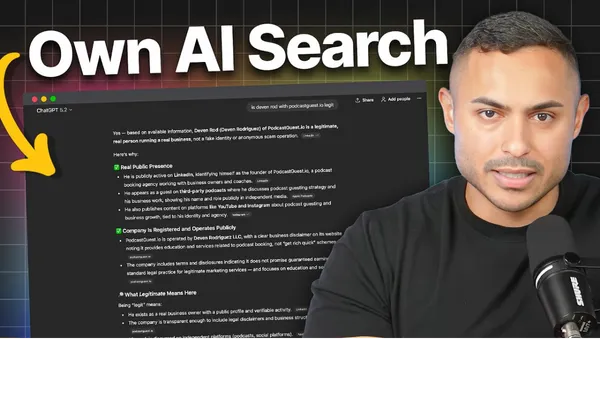
AI search is fundamentally changing how your ideal clients decide whether to trust you with their money. Instead of going to Google, people are now asking ChatGPT, Claude, and other large language models one simple question: "Is this person legit?"
And here's the problem. Most business owners have absolutely no idea what these AI platforms are saying about them. Worse, they don't realize that AI might be actively recommending their competitors or even associating them with fraud accusations from someone with a similar name.
This isn't theory. This is happening right now to business owners who are losing deals and don't even know why. The good news? There's a systematic way to influence what these LLMs say about you. And podcasts are the most powerful tool to do it.
Why AI Search Is Actively Screwing Business Owners Without Them Knowing
Here's a real example of how AI search can destroy your reputation without you ever knowing it happened.
A client (let's call him John Smith) was starting a real estate fund where investors could put in a minimum of $100,000. Before working together, a simple ChatGPT search was run on his name and company. The results were absolutely wild.
Because "John Smith" is a common name, ChatGPT found a DIFFERENT John Smith who was a 100% verified fraud. This other John Smith ran a real estate fund that was deemed a Ponzi scheme. He was accused of literally robbing people.
Now think about this. The real John Smith goes on a podcast and talks about his legitimate real estate fund. Someone in the audience gets interested. They go to ChatGPT and type "Is John Smith legit?" And what do they see? Fraud accusations. Ponzi scheme. Securities violations. None of it is about the real John Smith, but the potential investor doesn't know that.
This happened to another business owner in the trading space. His show rate suddenly tanked. After digging into it, he discovered that someone else with his exact name had been sued by the SEC and FTC for running a Ponzi scheme. Every time a potential client researched him on ChatGPT, that's what popped up.
Another client had an F rating with the Better Business Bureau from 10 years ago showing up in ChatGPT responses. Decade-old information was actively killing his deals today.
The pattern is clear: AI search is either actively working against you, or it's recommending competitors who understand how to influence these algorithms better than you do.
How AI Search Works: Training Data vs Live Search Explained
To control what AI search says about you, you first need to understand how these large language models actually pull data. There are two primary ways.
The first is training data. When these LLMs were originally created, they sourced every single bit of information that existed on the planet. Billions (if not trillions) of data points were fed into the system. Now whenever someone asks "who's the best podcast booking agency" or "is this person legitimate," the AI looks at all that stored data and searches for patterns.
This is why old negative information can haunt you. If there was something negative about you (or someone with your name) when the AI was trained, that information is baked into the system. The AI sees patterns based on historical data.
The second is live search. This is even more important because it's happening in real-time. When someone searches for your name, modern AI tools actively go out and look at new information across websites, social platforms, and media.
Here's what that means for you: You can influence both. Training data is harder to change (you'd need to create so much positive content that it overwhelms the old patterns). But live search is where you have real power, because the AI is actively looking for fresh information about you right now.
This is where podcasts become your most powerful weapon. Every podcast appearance creates new, indexable content that shows up in live searches. Stack enough of them strategically, and you start to overwhelm the old training data with new patterns.
The Psychological Safety Problem: Why Trust Is the Currency That Converts
Before we dive into the five factors that influence AI search, you need to understand why people are using ChatGPT to research you in the first place.
It comes down to one thing: psychological safety.
Here's the reality. So many people in today's marketplace have been burned. They've invested money in gurus who promised the world and delivered nothing. They've put money into funds, trading algorithms, courses, and services that turned out to be complete garbage.
What that does is create emotional scars. Now before anyone makes a significant financial investment, they first require what we call psychological safety. They need to feel safe before they'll even consider giving you money.
Think about a $100,000 investment. That's not a decision someone makes lightly. They need massive amounts of psychological safety before they'll commit. And where do they go to get that safety? They go to ChatGPT and ask: "Is this person legit?"
What they're really looking for is evidence of one of two things: Can I trust this person, or can I NOT trust this person?
When they search your name and see fraud accusations (even if it's the wrong person), trust immediately erodes. Psychological safety plummets. The deal is dead before you ever knew it existed.
But when they search your name and see consistent evidence that you're a trusted expert, their brain categorizes you as "safe." Psychological safety increases. And they move forward.
The formula is simple: More trust = More psychological safety = Higher conversion.
Pattern Density: How to Show Up More Often in AI Search Results
Now let's break down the five factors that influence what AI search says about you. The first factor is pattern density.
Pattern density means: How many times do you show up in connection with your topic?
If you only appear once connected to your area of expertise, the AI isn't going to see much of a pattern. You're not "dense" when it comes to that topic. But when you consistently appear as a guest on podcasts over time, something powerful happens. The LLMs start to see a pattern where YOU are now associated with THAT specific topic.
Here's a concrete example. If someone appears alongside "podcast booking" in 20 different podcast episodes, there's now a clear pattern. If they appear in 200 episodes, that pattern becomes overwhelming. The more pattern recognition the AI sees, the more likely it is to produce you as the subject matter expert when someone searches for help in that area.
This is why going on podcasts consistently over time is so powerful. Each appearance is another data point. Each data point strengthens the pattern. Each pattern increases your visibility in AI search results.
The key insight: One podcast appearance is nice. Twenty starts to create a pattern. Two hundred makes you undeniable.
Source Credibility: Why Niche Podcasts Beat Massive Audiences for AI Visibility
The second factor influencing AI search is source credibility. This is about WHERE you're being mentioned.
Not all podcast appearances are created equal in the eyes of AI. If you go on a podcast that started last week with three listeners, it's not going to be counted as a credible source. The AI basically ignores it.
But if you go on a highly niched podcast that is a thought leadership platform within your specific domain, the AI sees that very differently. It says "Wow, this is incredibly credible. This person must be an expert in what they do."
This is why going on garbage podcasts does absolutely nothing for AI search optimization. There's no source credibility. The AI doesn't care that you appeared on a show nobody listens to.
Here's what the AI is looking for:
Is this podcast established? (How long has it been running? How many episodes?)
Is it niche-specific? (Does it focus on a particular topic or industry?)
Does it have an engaged audience? (Downloads, reviews, listener engagement)
Is the host respected in their field?
The strategy: Go on fewer, more credible podcasts rather than mass-booking low-quality shows. Quality beats quantity when it comes to source credibility. One appearance on a highly respected industry podcast is worth more than 10 appearances on random shows with no audience.
Third Party Validation: How Podcast Appearances Build Trust Through Expert Endorsement
The third factor is third party validation, and this is where podcasts become uniquely powerful.
Here's the difference between podcast appearances and other forms of content. When you post on LinkedIn or Instagram, you're saying "I'm the best." It's self-promotion. AI (and humans) are naturally skeptical of self-promotion.
But when you go on a podcast, something different happens. You're being interviewed by a host who already has trust with their audience. That host is bringing you onto THEIR platform and exposing you to THEIR people. By doing that, they're essentially saying "this person is worth your time."
This is called trust transfer. The host's credibility transfers to you simply by having you on their show. The AI sees this and thinks "Wow, this person has tons of third party validation."
Now multiply that across dozens of podcast appearances. Each one is another third party validating your expertise. Each one is another trusted source saying "this person is the real deal."
The AI aggregates all of this. It sees:
This expert was invited on Podcast A (validation)
This expert was invited on Podcast B (validation)
This expert was invited on Podcast C (validation)
Now you're not just claiming to be an expert. Multiple third parties are validating that claim. And that carries massive weight in AI search results.
Specificity of Claims: Why Vague Promises Kill Your AI Search Presence
The fourth factor is specificity of claims. This is something most people completely miss.
AI algorithms hate vague claims. Statements like "I help a lot of people" or "I get you in front of big audiences" or "I help you lose a lot of weight" carry almost no weight in AI search optimization.
What AI loves is specificity. "I help people lose 40 pounds" is dramatically better than "I help people lose weight." The specific claim is more believable, more memorable, and more likely to be surfaced in search results.
Here's where podcasts become powerful for specificity. When you're on a podcast, you have the time to go deep. Unlike a 30-second ad or a quick social post, a podcast gives you 30 to 60 minutes to make specific, detailed claims about what you do and the results you get.
And when you repeat those specific claims across multiple podcast appearances, they become a pattern. The AI picks up on it: "This person consistently claims they help clients achieve [specific outcome]."
Examples of vague vs. specific claims:
Vague: "We help you get on podcasts" | Specific: "We get business owners on 20+ niche podcasts in 90 days"
Vague: "We increase revenue" | Specific: "Our clients average 6-figure returns from podcast appearances"
Vague: "We build authority" | Specific: "We position you as the go-to expert that ChatGPT recommends"
The more specific your claims, the more legitimate you appear to these AI platforms. And the more legitimate you appear, the more likely they are to recommend you.
Consistency and Omnipresence: How to Make AI Form a Clear Picture of Who You Are
The fifth and final factor is consistency (which also means omnipresence). This might be the most important factor of all.
Here's what AI is ultimately looking for: Is this person saying the same message everywhere?
When someone searches your name on ChatGPT, the AI doesn't just look at one source. It checks YouTube. It checks LinkedIn. It checks Instagram. It checks your website. It's looking for consistency in your messaging across all platforms.
If there's incongruency (you're saying one thing on podcasts and something different on social media), the AI gets confused. It thinks "Well, he can't really be that legit because there's no consistency in his messaging."
But when your messaging is pared and mirrored across all platforms, something powerful happens. The AI says "This person is consistent. This person can be trusted. This person has a clear message."
This is where podcasts create a massive advantage. When you do a podcast correctly, you can take that content and create consistent messaging across:
YouTube (full episode or clips)
LinkedIn (posts, articles, newsletters)
Instagram (reels, stories, posts)
Twitter/X (threads, quotes)
Your website (blog posts, case studies)
One podcast appearance can become dozens of content pieces across all platforms. And because they all come from the same source, the messaging is automatically consistent. The AI sees the same message everywhere it looks.
Consistency helps AI form a crystal clear picture of who you are and what you do. And when the AI has a clear picture, it's much more likely to recommend you.
How Podcast Transcripts and Show Notes Get Indexed by AI Algorithms
Now here's a bonus factor that makes podcasts even more powerful for AI search optimization: the technical side of how podcast content gets indexed.
YouTube Transcription: If a podcast has a YouTube channel (and most do), YouTube automatically takes the audio from every video and creates a transcript. That transcript gets fed directly to Google. And what gets fed to Google influences all the major AI platforms.
So when you go on a podcast that has a YouTube channel, your words, your specific claims, your messaging, it all gets transcribed and indexed. Now when someone asks ChatGPT about your topic, that information is searchable.
Show Notes: Every podcast has show notes. These appear on:
Apple Podcasts
Spotify
Podcast hosting platforms (Libsyn, Buzzsprout, etc.)
The podcast's website
All of those show notes are indexable. The AI's live search goes to these sources and pulls information about you. If your name, expertise, and specific claims are in those show notes, they become part of what AI surfaces when someone researches you.
Episode Titles: If you consistently have podcast episode titles that position you as an expert ("[Your Name] Reveals How to [Specific Outcome]"), those titles create patterns. The AI sees: "This person is featured as an expert in [topic] across multiple podcasts."
The technical takeaway: Podcast appearances create multiple indexable touchpoints that AI algorithms crawl and factor into their recommendations. It's not just the audio. It's transcripts, show notes, titles, clips, and all the derivative content you create from each appearance.
The Five Factor Framework: Putting It All Together for AI Search Domination
Let's put the entire AI search optimization framework together. When someone goes to ChatGPT and searches your name, here's what the AI is synthesizing:
1. Pattern Density: How often does this person show up connected to this topic? (More podcast appearances = stronger patterns)
2. Source Credibility: Where is this person being mentioned? (Established, niche podcasts = high credibility)
3. Third Party Validation: Is someone else vouching for this person? (Podcast hosts = trusted endorsement)
4. Specificity of Claims: Are their claims specific and believable? (Podcasts allow you to go deep)
5. Consistency: Is the same message everywhere? (Podcast content distribution = omnipresence)
Here's the beautiful part: Podcasts naturally hit all five factors.
Going on podcasts consistently forms patterns. Going on established, niche podcasts provides source credibility. Being interviewed by a host gives third party validation. The long-form format allows you to make specific claims. And distributing that content across platforms creates consistency.
No other marketing channel naturally hits all five factors. Ads don't give third party validation. Social posts lack source credibility. Blog posts don't create pattern density quickly. Only strategic podcast appearances check every box.
How to Audit What AI Currently Says About You and Your Competitors
Before you start implementing this AI search optimization strategy, you need to know your current baseline. Here's how to audit what AI currently says about you.
Step 1: Search Your Own Name
Go to ChatGPT and ask:
"Is [Your Name] legit?"
"Who is [Your Name]?"
"Should I work with [Your Name/Company]?"
"What does [Your Name] do?"
Document what comes up. Is it accurate? Is it positive? Is there confusion with someone else who has your name?
Step 2: Search Your Topic
Now search for your area of expertise:
"Who's the best [your industry] expert?"
"Who should I hire for [your service]?"
"Who's the top [your niche] in [your location]?"
Do you show up? If not, your competitors are beating you in AI search. You need more pattern density, source credibility, and third party validation.
Step 3: Search Your Competitors
Research what AI says about your top competitors. Look for:
What podcast appearances show up in their results?
What specific claims are being surfaced?
How are they being positioned as experts?
This tells you what you're competing against. If a competitor is showing up and you're not, they've done the work to influence AI search. Now you know you need to catch up.
The audit reveals your starting point. From there, it's about systematically building pattern density through strategic podcast appearances on credible shows that give you third party validation while you make specific claims and distribute that content consistently.
The Bottom Line
AI search is the new reality. Your ideal clients are using ChatGPT, Claude, and other LLMs to research you before they ever reach out. If you don't control what these platforms say about you, you're either losing deals to competitors or getting screwed by algorithm errors that associate you with the wrong person.
The five factors (pattern density, source credibility, third party validation, specificity of claims, and consistency) determine what AI recommends. And strategic podcast appearances are the most effective way to influence all five factors simultaneously.
The business owners who understand this are already implementing it. They're getting on credible podcasts, making specific claims, distributing that content everywhere, and watching their AI search presence grow.
The question is: Are you going to be the one ChatGPT recommends? Or are you going to keep losing deals to someone who figured this out before you did?