
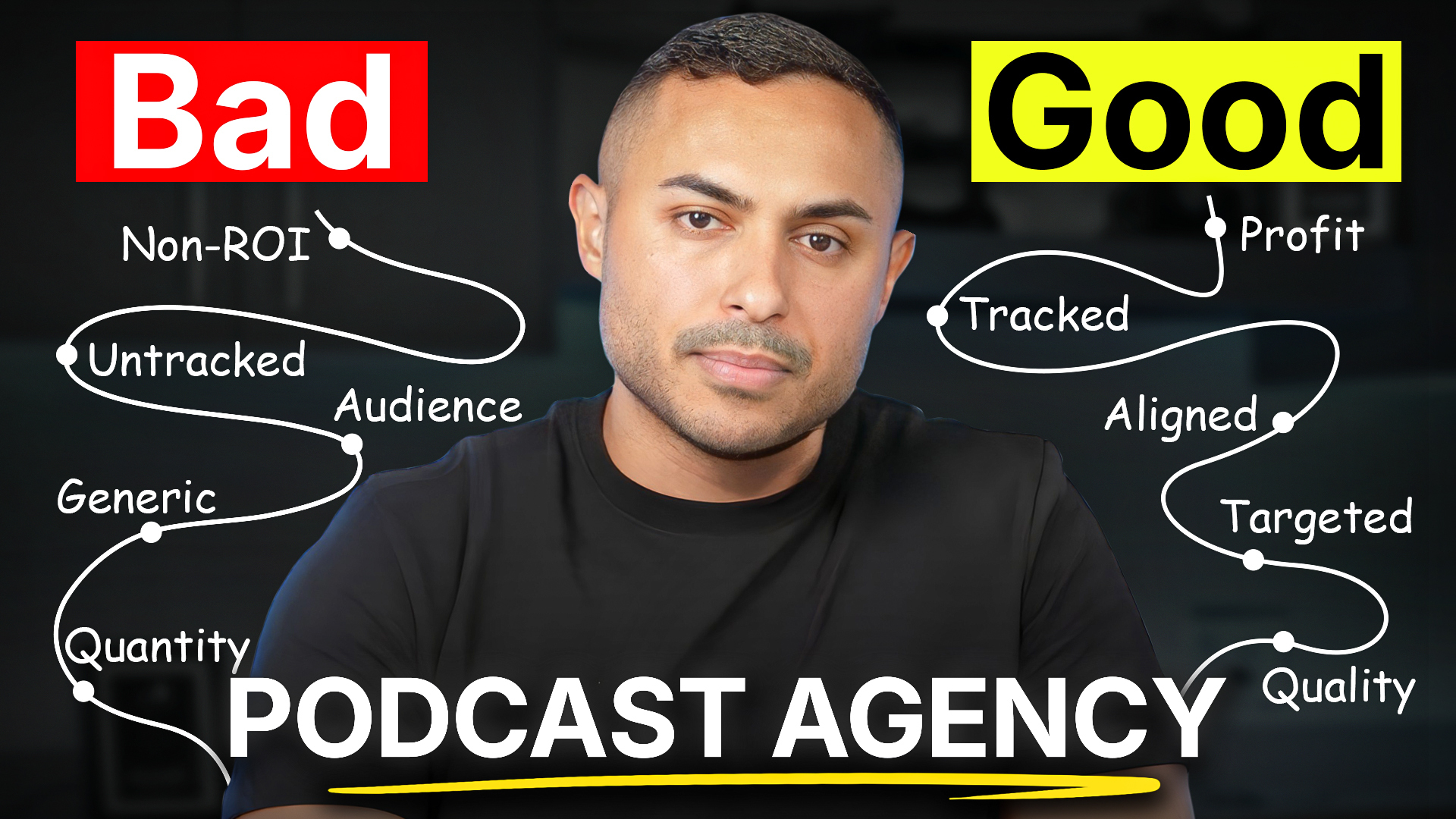
How to Hire a Podcast Booking Agency Without Wasting Money Using Seven Critical Vetting Questions
Article Description: Most business owners hire podcast booking agencies and see zero ROI from hundreds of hours and thousands of dollars spent. This article breaks down the seven deadly mistakes companies make when hiring agencies and the exact vetting questions that reveal which agencies actually convert podcast appearances into revenue.
TABLE OF CONTENTS:
Why 90% of Business Owners Make Expensive Mistakes Hiring Podcast Booking Agencies
The Quantity and Vanity Trap: Why 50 Podcast Bookings Waste More Money Than 5 Targeted Shows
Why Top 10% Global Rankings Mean Absolutely Nothing for Podcast ROI
The Spray and Pray Problem: How Untargeted Podcast Placement Destroys Conversion Rates
HyperTargeted Placement Strategy: The Four-Point Audience Validation Framework
Why Most Agencies Have Zero Conversion Systems and How to Spot This Red Flag
Market Sophistication Levels: Why 2015 Strategies Fail in Today's Trust Recession
The Attribution Tracking Question Every Agency Must Answer Before You Hire Them
Four-Phase Podcast Conversion System: Retention, Urgency, Pre-Selling, and Distribution
How to Maximize Listener Retention to Increase Podcast Conversion Rates
Urgency-Based Podcast Offers: The Five Psychological Components That Drive Action
The 7-11-4 Rule: Why Content Distribution Across Four Platforms Increases Close Rates
OPENING SECTION:
If you're looking to hire a podcast booking agency, there's a 90% chance you're about to make a very expensive mistake. Most business owners spend thousands of dollars and hundreds of hours getting booked on podcasts only to see zero leads, zero sales calls, and zero revenue from their appearances.
The problem isn't podcasts. The problem is that most podcast booking agencies focus on the wrong metrics—bookings, downloads, and vanity rankings—instead of the only metric that actually matters: conversion into revenue.
Here's what typically happens: An agency promises to get you on 30, 40, or 50 podcasts. They throw around impressive-sounding stats like "top 10% of all podcasts globally." You go on dozens of shows, spend hours recording interviews, and wait for the leads to roll in. Nothing happens. When you ask the agency what went wrong, they shrug and say, "Podcasts just don't work for your business."
Wrong. Podcasts work incredibly well when you hire an agency that understands two critical things: targeted audience placement and conversion systems. This article breaks down the seven deadly mistakes business owners make when hiring podcast booking agencies and the exact vetting questions that separate agencies who drive ROI from agencies who waste your time and money.
Why 90% of Business Owners Make Expensive Mistakes Hiring Podcast Booking Agencies
Most business owners approach hiring a podcast booking agency the same way they'd hire any other vendor: they look at credentials, client lists, and promises of results. But podcast marketing is fundamentally different from other marketing channels, and the criteria that work for hiring a Facebook ads agency will destroy your ROI when hiring a podcast booking agency.
Here's the pattern that plays out over and over: A seven or eight-figure business owner gets on a sales call with an agency. The agency shows impressive client logos, promises bookings on "top-tier podcasts," and talks about exposure and brand building. The business owner thinks, "This sounds great. Let's do it." They sign a contract, pay thousands of dollars upfront, and three months later they're sitting on their couch wondering why they haven't booked a single sales call from any of their podcast appearances.
The mistake happens in that initial sales call. Most business owners don't ask the right vetting questions because they don't understand what actually drives podcast ROI. They focus on surface-level metrics—number of bookings, download numbers, show rankings—instead of the two factors that actually determine whether podcasts generate revenue: audience targeting and conversion infrastructure.
Think about it this way: If an agency gets you booked on 50 podcasts with a combined audience of 10 million people, but none of those 10 million people are your ideal client and you have no system to convert interested listeners into booked sales calls, what's the point? You've just spent hundreds of hours and thousands of dollars on what amounts to expensive entertainment.
The businesses that generate six-figure returns from podcast appearances ask completely different questions during the vetting process. They don't care about vanity metrics. They care about audience alignment, conversion systems, attribution tracking, and measurable ROI. This article shows you exactly what questions to ask and what red flags to watch for so you don't become another cautionary tale of wasted podcast marketing budgets.
The Quantity and Vanity Trap: Why 50 Podcast Bookings Waste More Money Than 5 Targeted Shows
Here's a story that perfectly illustrates the biggest mistake business owners make when hiring podcast booking agencies. Last Friday, I spoke with an eight-figure business owner named Rich. Rich was going on 10-plus podcasts per week. Not per month. Per week. That's over 500 hours per year spent recording podcast interviews.
When I asked Rich about his results, he said, "Not really seeing anything." An eight-figure business owner spending 10 hours per week on podcast appearances and generating zero measurable results. Why? Because the agency he hired operated on a quantity-over-quality model.
The quantity trap works like this: An agency promises to get you booked on 30, 40, or 50 podcasts. This sounds impressive. More is better, right? Wrong. What these agencies are actually doing is compensating for lack of quality with sheer volume. They can't get you on highly targeted, high-quality podcasts that actually reach your ideal clients, so they flood you with bookings on mediocre shows and hope something sticks.
The math here is brutal. Let's say you're a business owner whose time is worth $1,000 per hour (which is conservative for a seven or eight-figure entrepreneur). If you spend one hour recording each podcast interview and go on 50 podcasts, you've just invested $50,000 worth of your time. If those podcasts don't convert into revenue because the audiences are wrong, you've essentially lit $50,000 on fire.
Now compare that to a targeted approach: What if you went on just five highly targeted podcasts where the audience is 100% aligned with your ideal client profile? You'd spend $5,000 worth of your time, and because the audience is right, your conversion rate would be exponentially higher. Quality beats quantity every single time when the goal is revenue, not ego.
Here's what I asked Rich: "What if we could get a way better result by going on just one high-quality podcast per week rather than 10 low-quality podcasts?" His entire demeanor changed. That's what he actually wanted—higher quality, better results, and 90% of his time back to focus on running his business.
The question to ask on a sales call: "How do you prioritize quality over quantity? What's your process for ensuring I'm not wasting time on low-value podcast appearances?"
Why Top 10% Global Rankings Mean Absolutely Nothing for Podcast ROI
Here's the second half of the quantity and vanity trap: agencies use impressive-sounding statistics that mean absolutely nothing to convince you their podcasts are high quality. The most common one? "This podcast is in the top 10% of all podcasts globally."
Sounds great, right? Top 10% must mean it's a massive, influential show. Except here's the problem: that statistic is completely unsubstantiated and has zero correlation with audience size, engagement, or conversion potential.
The data for global podcast rankings comes from a company called ListenNotes. One day, I decided to email the founder of ListenNotes and ask the obvious question: "What does the global ranking actually mean? What's the formula?" His response? "That is proprietary information we cannot divulge. It is a formula internal to us."
Translation: The ranking system is a black box. No one knows what it measures. It could be based on submission date, number of episodes, update frequency, or any combination of factors that have nothing to do with actual audience size or quality. Agencies use this metric because it looks good on paper, but it tells you absolutely nothing about whether the podcast will drive results for your business.
Think about what matters for podcast ROI: You need to know how many people will actually hear your interview, what percentage of that audience matches your ideal client profile, and what the engagement level is. A podcast could be in the "top 10%" globally and have 500 downloads per episode with an audience that has zero interest in your services. Meanwhile, a podcast outside the top 10% could have 20,000 downloads per episode with an audience that's 80% aligned with your ideal client profile.
The agencies using vanity metrics like global rankings are doing so because they don't have real data on audience size, demographics, or engagement. They're hiding behind impressive-sounding but meaningless statistics because the actual metrics would reveal their podcasts don't deliver results.
The question to ask on a sales call: "How do you actually measure how many people I'm going to get in front of on these podcasts? Can you show me download numbers, audience demographics, and engagement metrics for the specific shows you're recommending?"
If they can't answer with precision, run. You're about to waste your money on a company that operates on hope and guesswork rather than data and strategy.
The Spray and Pray Problem: How Untargeted Podcast Placement Destroys Conversion Rates
Let's go back to Rich for a moment. When I asked him why his podcasts weren't producing results, he said, "The people getting me booked on these podcasts aren't even getting me in front of the right audiences. The company is kind of just taking a spray and pray approach."
Then I asked him a simple question: "Rich, you're an eight-figure business owner, right? Did you get that way by taking a spray and pray approach to growing your business, or were you very precise in how you set goals, strategized, and executed?" He said, "No, man. I was dialed in. I was very precise."
So why was Rich trying to take a spray and pray approach to podcast marketing when that's the complete opposite of the formula that built his business? Because the agency he hired didn't understand audience targeting at a sophisticated level.
Here's what most podcast booking agencies do: They look at your industry and make broad assumptions. "Oh, you're in marketing? Let me get you on business podcasts." "You're a leadership coach? Let me get you on entrepreneurship podcasts." They treat podcast placement like throwing darts with a blindfold on and hoping one of them hits the target.
But here's the reality: If I could get you in front of 100 million people, but nobody in that audience actually cares about what you have to say or can afford your services, is it worth it? Absolutely not. You're not here for ego and exposure. You're here to grow your business and generate revenue.
There are three critical factors that determine your ability to convert podcast appearances into revenue: the right message, the right person, and the right time. If you're going on a bunch of podcasts and the agency you hired is taking a spray and pray approach, you're not going to nail any of those three factors. You'll be delivering a message to the wrong people at random times, and it's going to feel like knocking on strangers' doors hoping someone is interested.
The alternative to spray and pray is what I call sniper-level targeting. When I was a captain in the United States Army, I loved working with snipers because they were extremely precise in how they targeted. They didn't take 1,000 shots hoping one would hit. They took one perfectly aimed shot that hit every time. That's how podcast placement should work.
Here's what "right people" actually means in the context of podcast marketing:
First, people who are already interested in what you do. It's exponentially easier to sell to someone who's already interested in your topic than to try convincing a stranger to care. If you sell B2B software, you want to be on podcasts where the audience is already researching B2B software solutions, not general business podcasts where 90% of listeners have zero interest in your category.
Second, people who have the financial capability and willingness to invest in what you sell. I always ask business owners: "You told me you wanted more leads, right?" They nod enthusiastically. Then I ask: "What if they're all broke? You still want them?" Suddenly they're not so enthusiastic anymore. If you want to leverage podcast appearances to grow your business, you must be on podcasts where the audience can actually afford your services.
The question to ask on a sales call: "How do you actually validate that the audience you're getting me in front of matches my ideal client profile and that they have the financial capability and willingness to pay what I'm worth?"
If the agency doesn't have a clear, data-driven process for validating audience alignment, they're taking a spray and pray approach with your time and money.
HyperTargeted Placement Strategy: The Four-Point Audience Validation Framework
Before any reputable podcast booking agency ever talks about conversion systems or monetization strategies, they need to nail the foundational element: Are they getting you in front of the right people? This is where most agencies completely fail.
Here's what typically happens: An agency looks at your industry and makes surface-level assumptions. They say, "Oh, you're in the marketing space? Let me get you on business podcasts." But they haven't done any validation. They don't have a vetting process or framework. So you go on these podcasts, they don't work, and you're left wondering why the agency told you these were good shows.
A hyperTargeted placement strategy works completely differently. Before an agency even considers a podcast for you, they need to become intimately familiar with your business. Not just "what industry are you in?" but deep understanding: What do you do? Who do you serve? What transformation do you provide? What's your cost of acquisition? What's your offer structure? Do you have a back-end continuity program?
Think about it this way: If an agency can't understand your business well enough to potentially join your sales team, how could they possibly go into the marketplace and find podcasts where your ideal clients are spending their time? They can't. They need to know your business as well as you do.
Once an agency truly understands your business, they can run your profile through a system that scans tens of thousands of potential podcasts, filtering for specific data layers: audience demographics, income levels, engagement metrics, content themes, and host quality. But here's where most agencies stop and the best agencies keep going: every podcast that comes out of that initial filter must go through a three-part vetting framework.
First: Audience Alignment. Does this audience reflect your ideal client? This requires running a strategic audience test with four critical components:
Is this audience financially qualified to afford what you offer?
Do they have the problem you solve?
Do they have the mindset that's open to your approach?
Would they naturally see value in your solution?
If a podcast doesn't pass all four checkpoints, it doesn't matter how big it is or how impressive it looks—it gets disqualified. Why? Because getting you on that podcast would reduce your conversion rate and waste your time.
Second: Topic Alignment. Does what you talk about naturally fit into the content theme of this specific podcast? If your topic feels forced or tangential to the show's usual content, the audience isn't there to hear from you. That means low retention, low trust, and low conversion.
Third: Host and Show Quality. Unfortunately, many agencies will get you booked on podcasts that started last week in someone's basement with terrible audio quality and an unprofessional host. If you're building a brand (which you should be), this is disastrous. A brand is an association between two things. If you're going on podcasts with unprofessional hosts and low-quality production, you're associating yourself with that lack of professionalism. Prospects will view you as less of an authority, not more.
Every single podcast that a top-tier agency presents to you should have already been vetted for professionalism, production quality, and host competence. No exceptions.
The question to ask on a sales call: "Walk me through your exact process for vetting podcasts. How do you ensure the audience alignment, topic fit, and show quality before you ever present a podcast to me?"
If they can't articulate a clear, multi-step vetting framework, they're winging it. And you'll pay the price.
Why Most Agencies Have Zero Conversion Systems and How to Spot This Red Flag
Let's get back to Rich one more time. I asked him what might be the most important question of our entire conversation: "Rich, you've gone on hundreds of podcasts at this point and really haven't converted much at all. How did the agency teach you to convert on these podcasts? What was their system? What was the infrastructure they helped you build?"
His response? "They just told me to go on the podcasts. There really isn't a structure. There really isn't anything they told me how to do."
This is highway robbery. Here's why: If an agency just gets you booked on podcasts but doesn't have a system to help you convert those appearances into revenue, you are guaranteed to waste your money. But it's worse than that—their lack of professionalism in this area signals a lack of professionalism everywhere else.
Think about what you're actually buying when you hire a podcast booking agency. You're not buying bookings. You're buying revenue growth. Bookings are just a means to an end. If the agency only delivers bookings without helping you convert those bookings into sales calls and clients, they're selling you half a solution and charging you for the full thing.
Now, here's where agencies have gotten slick: They've caught on to the fact that business owners are asking about conversion systems, so they say something like, "We're going to develop this monetization system that's going to do these different things." But here's the problem: Most of these agencies aren't real direct response marketers themselves.
Look at how they currently market their own services. Are they running sophisticated paid advertising that drives pre-sold prospects to sales calls? Are they using advanced attribution tracking and backend systems? Or are they relying on referrals and outdated marketing tactics? If it's the latter, they don't understand modern conversion at a professional level. They're old-school operators trying to compete in a new-school market.
Sorry, not sorry. If it quacks like a duck, it's a duck. These agencies can't teach you what they don't know themselves.
Here's what most agencies will tell you their "conversion system" looks like: Send people to a landing page. Have them opt in. They go to a thank you page that says "check your inbox." Then they enter a nurture email sequence that ultimately does nothing. Maybe they book a call six weeks later when they happen to remember you exist.
This strategy worked in 2015 when you could run a Facebook ad to a video sales letter and make money hand over fist. But that was a level-one sophisticated market where trust was high and skepticism was low. We're now in a level-five sophisticated market where trust is at an all-time low and people have been burned too many times by gurus and sleazy marketers.
Using 2015 strategies in a 2025 market is like bringing a knife to a gunfight. It doesn't work.
The questions to ask on a sales call:
"How much revenue does your company generate?" If it's a low number, don't trust them to teach you conversion.
"What is the specific strategy you're going to teach me to convert podcast appearances into booked sales calls?"
"Can you show me examples of clients who've implemented your conversion system and the results they achieved?"
If they can't answer these questions with specifics, they don't have a real conversion system. They're just going to get you booked on podcasts and leave you to figure out the conversion part on your own.
Market Sophistication Levels: Why 2015 Strategies Fail in Today's Trust Recession
Understanding market sophistication is critical to understanding why most podcast booking agencies fail to deliver ROI. There are five levels of market sophistication, and the strategies that work at level one will destroy your results at level five.
Level One: New product in a new market. This is 2010-2015 in the online marketing world. Trust is high, skepticism is low. You can run a Facebook ad to a video sales letter and people will buy instantly. Why? Because they haven't been burned yet. The market is naive and optimistic.
Level Five: Skepticism is at an all-time high. This is 2020-2025 and beyond. Your prospects have been burned multiple times by gurus who promised the world and delivered nothing. They don't trust anybody. They've seen every tactic and every pitch. Trust is at an all-time low, and conversion requires significantly more proof, consistency, and sophistication.
Here's the problem: Most podcast booking agencies are using and teaching strategies that worked in a level-one market and trying to apply them to a level-five market. They tell you, "Just send people to your landing page and have them opt in. Then run them through a nurture sequence." That worked when trust was high. It doesn't work now.
In a level-five market, conversion requires multiple touchpoints across multiple platforms with consistent messaging. You can't just send someone to a landing page and expect them to book a call. They need to see you showing up consistently with the same message on LinkedIn, YouTube, Instagram, and in their inbox. They need to feel like you're everywhere, saying the same things, backing up your claims with proof.
This is what Google calls the "7-11-4 rule": Before someone buys from you, they need to spend 7 hours consuming your content across 11 different touchpoints on 4 different platforms. That's the baseline for building enough trust to convert in a level-five market.
But most podcast booking agencies don't understand this. They tell you to go on podcasts and send people to an opt-in page. That's it. One touchpoint. One platform. Zero consistency. And then they wonder why you're not getting results.
The agencies that actually drive ROI understand market sophistication. They know we're in a trust recession. They build conversion systems that account for the fact that trust is low and skepticism is high. They help you create consistent messaging across multiple platforms so that when someone hears you on a podcast, they can look you up and see the exact same message on LinkedIn, YouTube, your website, and everywhere else.
The question to ask on a sales call: "How does your conversion system account for the fact that we're in a low-trust, high-skepticism market? What's your strategy for building trust through consistency across multiple platforms?"
If they look at you like you're speaking a foreign language, they don't understand market sophistication. And that means their strategies are outdated and ineffective.
The Attribution Tracking Question Every Agency Must Answer Before You Hire Them
Here's one of the most frustrating conversations I have over and over with business owners who've hired podcast booking agencies: "Devon, I went on a bunch of podcasts, but I don't really know the results. I don't know which podcasts worked. I can't tell you how many leads I got from each show or how many sales calls were booked specifically from podcast listeners."
They're leaving everything up to chance because the agency they hired didn't have any attribution system in place to track data from each podcast appearance.
Think about how insane this is. You're spending thousands of dollars and hundreds of hours on podcast appearances, and you have no idea if any of it is working. You can't identify which podcasts drove results and which ones were a waste of time. You can't optimize your strategy because you have no data to base decisions on.
This is like running Facebook ads with zero tracking pixels. You'd never do it with paid advertising, but somehow business owners accept it with podcast marketing because the agency they hired told them, "Just trust the process. Podcasts work."
Attribution tracking is non-negotiable. Before you hire any podcast booking agency, they must be able to answer this question: "How do you track the data from each of my podcast appearances so I can see which podcasts performed well versus which ones didn't?"
Here's what proper attribution tracking looks like:
First: Unique tracking links for each podcast. Every podcast gets its own custom URL so you can see exactly how many people visited from that specific appearance. No generic "check out my website" nonsense. Unique links. Every time.
Second: Source tracking through your CRM or booking system. When someone opts in or books a call, you need to know exactly which podcast they came from. This requires technical setup on the backend that captures source data and passes it through your entire funnel.
Third: Dashboard reporting that shows podcast-specific metrics. You should be able to pull up a dashboard and see, for each podcast: How many people grabbed your offer, how many booked sales calls, how many showed up to calls, how many became clients, and what the revenue was. Complete visibility from start to finish.
Fourth: ROI calculation per podcast. At the end of the day, you need to know: "I spent X hours and Y dollars on this podcast. Did it generate positive ROI?" Without attribution tracking, you can't answer that question. You're operating on hope and gut feel.
Most agencies don't offer attribution tracking because they don't want you to know the truth: most of the podcasts they're booking you on don't drive results. If you had clear data showing that 8 out of 10 podcasts generated zero leads, you'd fire the agency immediately. They protect their business by keeping you in the dark.
Don't accept this. Demand attribution tracking before you sign any contract.
The question to ask on a sales call: "Walk me through your attribution tracking system. Show me exactly how I'll be able to see which podcasts are working and which aren't, down to the specific numbers: leads, applications, booked calls, and revenue per podcast."
If they don't have a clear answer with examples, don't hire them.
Four-Phase Podcast Conversion System: Retention, Urgency, Pre-Selling, and Distribution
After working with over 500 high-level business owners and getting them booked on more than 10,000 podcasts, here's what we've learned: The only thing that actually produces ROI is pairing the right podcasts with the right conversion systems.
You can get on the perfect podcast with an audience that's 100% aligned with your ideal client, but if you don't have a system to convert that attention into revenue, you'll still make $0. On the flip side, you can have the best conversion system in the world, but if you're going on the wrong podcasts, it won't matter.
Both elements must be present: targeted audience placement and sophisticated conversion infrastructure.
The conversion infrastructure that works in today's market is a four-phase system:
Phase 1: Maximize Listener Retention. It's not about how many people click play on your podcast episode. It's about how much of their attention you can hold. The longer someone listens to you, the more they trust you. The more they trust you, the more likely they convert. Retention equals conversion.
Phase 2: Craft an Urgency-Based Offer. Most people just tell podcast listeners to "check out my website" or "go to my landing page." This doesn't work because there's no compelling reason to act now. You need an offer that creates urgency and exclusivity—something listeners feel they'll miss out on if they don't act immediately.
Phase 3: Pre-Selling Systems. This is where you build the backend infrastructure that captures hot podcast leads and converts them into booked sales calls as fast as possible. This includes attribution tracking, automatic qualification to keep tire-kickers off your calendar, and multi-channel "manhunt" sequences that pursue interested leads until they book.
Phase 4: Content Distribution. This is where you turn one-time podcast appearances into long-term assets by strategically distributing the content across your organic marketing, paid advertising, and sales process. This creates the consistency that builds trust in a level-five sophisticated market.
All four phases must work together. Most agencies focus only on bookings (Phase 0, if you will). The best agencies help you implement all four phases so that every podcast appearance has the highest possible chance of generating revenue.
The next four sections break down each phase in detail so you know exactly what to look for when vetting podcast booking agencies.
How to Maximize Listener Retention to Increase Podcast Conversion Rates
Here's a truth most people don't think about: It doesn't matter how many people click play on your podcast episode if they stop listening after three minutes. If they don't stay until the end, they don't hear your offer. If they don't hear your offer, they can't convert. If they can't convert, you make $0.
This is why Phase 1 of the Podcast Conversion System focuses on maximizing listener retention. The goal isn't just to get people to start listening. The goal is to get them to stay from beginning to end.
Here's why retention matters so much: The longer someone listens to you, the more they trust you. The more they trust you, the more likely they convert. This is basic psychology. When someone listens to your voice for 30, 45, or 60 minutes, their brain processes that as a social interaction—even though it's one-way communication. The parasocial relationship that develops creates familiarity, and familiarity breeds trust.
Think about your own experience. When you listen to a podcast host regularly, don't you start to feel like you know them? Like they're a friend you haven't met in person yet? That's retention creating trust. And that trust is what makes people pull out their credit card and invest.
So how do you maximize retention? This isn't about "public speaking 101" or "how to tell your story." That's amateur-hour stuff. This is about leveraging proven psychological principles to ensure people stay from beginning to end.
Here are the core principles:
Pattern interrupts. The human brain is designed to tune out predictable patterns. If you talk in the same rhythm with the same energy for 45 minutes straight, people zone out. You need to interrupt the pattern—change your energy, ask a question, tell a story, pause for effect. These interrupts snap people back to attention.
Open loops. Introduce an idea but don't complete it right away. "I'm going to share the exact strategy we used to generate $500K from one podcast appearance, but first let me explain why most people fail..." Now the listener can't stop listening because you haven't closed the loop. They need to know what the strategy is.
Stakes and consequences. People pay attention when something matters. If you're just sharing interesting information with no stakes attached, retention drops. But if you're explaining what will happen if they don't implement what you're teaching—the money they'll lose, the opportunities they'll miss—retention skyrockets.
Specificity and examples. Vague concepts don't hold attention. "You need better marketing" puts people to sleep. "If you change your Facebook ad headline from 'Learn about marketing' to '7-figure business owners: Here's how to cut your CAC in half,' your CTR will double" keeps them locked in.
These aren't tactics you figure out on your own. A professional podcast booking agency should walk you through retention best practices before you ever record your first interview. If they just book you on podcasts and leave you to wing the retention part, they're setting you up to fail.
The question to ask on a sales call: "What training or guidance do you provide to help me maximize listener retention so people actually stay until they hear my offer?"
If they don't have a clear answer, they don't understand that retention drives conversion.
Urgency-Based Podcast Offers: The Five Psychological Components That Drive Action
Let's be real for a second: Most people go on podcasts and have absolutely no idea what to offer. They say things like "check out my website" or "follow me on Instagram" or "go to my landing page." Then they wonder why nobody takes action.
Here's why those approaches don't work: There's no urgency and no exclusivity. "Check out my website" can be done anytime. There's no compelling reason to do it now. "Follow me on Instagram" is something you can do whenever you remember, which means most people never remember. "Go to my landing page" feels generic and impersonal.
If you want podcast listeners to take action, you need an urgency-based offer that's specifically tailored to that podcast audience. An offer that creates an insatiable desire and makes people feel like they'll miss out on something massive if they don't act immediately.
Here's what an urgency-based offer looks like: "I've put together a free training exclusively for [podcast name] listeners where I break down the exact five-step framework we used with a client to generate $500K in 90 days. This training isn't available anywhere else on the internet, and I'm only keeping it up for the next 72 hours. If you want access, go to [custom URL] right now and grab it before it comes down."
Notice the difference? There's urgency (72 hours), exclusivity (only for this podcast's listeners), specificity ($500K in 90 days, five-step framework), and a clear action step (custom URL).
There are five psychological components that go into creating offers like this:
1. Exclusivity. The offer must feel like it's specifically for this podcast's audience. It's not something everyone gets. It's special treatment for this community. This triggers FOMO (fear of missing out) and makes people feel like insiders.
2. Time constraint. The offer must have a deadline. 72 hours, 7 days, end of the month—whatever makes sense for your business. Without a deadline, there's no reason to act now. With a deadline, people prioritize taking action because they don't want to miss out.
3. Specificity. Vague offers don't create desire. "Get my free guide" is forgettable. "Get my 14-page blueprint showing the exact ads we're running right now that generate $3 leads" creates desire because it's specific and tangible.
4. Value demonstration. You need to articulate exactly what transformation or outcome they'll get from taking you up on the offer. Not features—outcomes. "You'll learn how to cut your customer acquisition cost in half" is better than "You'll get a course on Facebook ads."
5. Believable framing. This is where most people screw up. You can have all four components above, but if you frame the offer in a way that sounds too good to be true or doesn't align with the audience's worldview, they'll ignore it. The framing must feel believable and achievable for that specific audience.
A professional podcast booking agency should help you craft this offer using these five components and then coach you on the specific language and framing to present it during the podcast interview. If the agency just says "figure out what you want to offer and mention it during the interview," they don't understand conversion psychology.
The question to ask on a sales call: "How do you help me craft podcast-exclusive offers that create urgency and drive immediate action?"
If they don't have a framework, they're leaving your conversion up to chance.
Pre-Selling Systems: Attribution Tracking, Automatic Qualification, and Multi-Channel Manhunt Sequences
Here's where most podcast marketing strategies completely fall apart. Someone hears you on a podcast, gets interested, and clicks your link. They land on a page that says "Enter your name and email." They do. Then they're sent to a "Thank You" page that says "Check your inbox."
Now what? They're thrown into some generic email drip sequence that was built months ago for a different purpose. Maybe they book a call six weeks later if they happen to remember you exist. More likely, they forget about you entirely and you lose a hot lead that was pre-sold and ready to buy.
This is insane. A podcast lead is the hottest lead you'll ever have. They just spent 30-60 minutes listening to you. They trust you more than someone who clicked a Facebook ad and watched a 2-minute video. They're ready to buy. And you're treating them the same as a cold lead who opted in for a checklist?
Phase 3 of the Podcast Conversion System solves this by building custom backend infrastructure that does three critical things:
First: Attribution tracking. You need to know exactly which podcasts are actually driving results and which ones are wasting your time. This means unique tracking links for each podcast, source tags that follow people through your entire funnel, and dashboard reporting that shows podcast-specific metrics: leads, applications, booked calls, show-ups, closes, and revenue.
Without attribution tracking, you're flying blind. You have no idea which podcasts are working. You can't optimize your strategy. You can't tell the agency "Get me on more podcasts like this one and fewer like that one." You're just hoping things work out, which is not a strategy.
Second: Automatic qualification. Not everyone who hears you on a podcast should get access to your calendar. You don't want tire-kickers booking sales calls and wasting 30 minutes of your closer's time. You need a system that automatically qualifies leads and only lets the right people through.
This looks like qualification questions before someone can book: "What's your annual revenue?" "How much are you currently spending on [problem you solve]?" "Are you the decision-maker?" These questions filter out people who aren't ready or aren't qualified, protecting your calendar from low-value leads.
The qualified leads see your calendar and book immediately. The disqualified leads get a polite message explaining this isn't the right fit at this time, along with an alternative resource or next step. This way you're not burning bridges, but you're also not wasting time on calls that will never close.
Third: Multi-channel manhunt sequences. Here's the reality: Not everyone who grabs your offer will book a call immediately. Some people get distracted. Some want to think about it. Some forget. If you just let these leads go cold, you're leaving money on the table.
A manhunt sequence is a coordinated campaign across multiple channels (email, SMS, retargeting ads, direct outreach) that pursues leads until they either book a call or explicitly tell you to stop. The goal is to make it impossible to forget about you.
Here's why this matters: If you don't get a hot lead to book within the first 24 hours, your chances of converting them drop by 80%. Studies show this. The clock is ticking from the moment they grab your offer, and every hour that passes reduces conversion probability.
A multi-channel manhunt sequence keeps you top-of-mind and creates multiple opportunities for them to book before they go cold. Email sequence, SMS reminders, retargeting ads on Facebook and Instagram, maybe even a personal text or voicemail from a team member. You're surrounding them with opportunities to take the next step.
A professional podcast booking agency should help you build all three of these systems before you ever go on your first podcast. If they're just booking you on shows and leaving the backend infrastructure up to you, you're going to waste the majority of leads that come from your appearances.
The question to ask on a sales call: "Walk me through how you help me build the backend pre-selling systems: attribution tracking, automatic qualification, and lead nurture sequences."
If they don't have a clear process, they're not equipped to help you convert.
The 7-11-4 Rule: Why Content Distribution Across Four Platforms Increases Close Rates
Here's a problem I see every single day: Business owners view podcast appearances as one-time events. They go on a podcast, maybe get a few leads, and move on to the next one. They're treating podcasts like they'd treat a speaking gig—show up, deliver value, hope something happens.
But this is like buying a Ferrari and never taking it out of first gear. You're wasting 90% of the potential value.
Here's what should happen instead: Every podcast appearance should be turned into a long-term asset that gets strategically distributed across every platform your prospects use to vet you. Why? Because we're living in what I call a "trust recession."
Your prospects have been burned too many times by gurus and sleazy marketers who promised the world and delivered nothing. Trust is at an all-time low. People don't know who to believe anymore. They've seen every tactic and every pitch, and they're skeptical of everyone.
This is why Google's research found that before someone buys from you, they need to spend 7 hours consuming your content across 11 touchpoints on 4 different platforms. They call it the "7-11-4 rule," and it represents the baseline amount of exposure required to build enough trust to convert in today's market.
Think about what this means for your podcast strategy. Someone hears you on a podcast for 45 minutes. That's one touchpoint on one platform. They're intrigued, so they Google you. What do they find?
If your messaging is consistent across every platform they look—LinkedIn, YouTube, Instagram, your website—trust skyrockets. They see you saying the same things everywhere. The message is consistent. You're showing up professionally on every platform. They think, "This person is legit. They're everywhere, and they're consistent. I should work with them."
But if your message is scattered or inconsistent, they move on. Maybe your LinkedIn talks about one approach, your website emphasizes something different, your Instagram is a random mix of personal content and business tips. They think, "This person doesn't have their act together. I'm going to find someone who seems more credible."
Here's the brutal truth most business owners don't want to hear: You're not just losing podcast leads because of inconsistent messaging. You're losing leads from every source—referrals, Google searches, social media, paid ads. If someone looks you up and sees inconsistency, they assume you're not a professional. They hire someone else.
But imagine this: Someone hears you on a podcast. They Google you—same message. They check your LinkedIn—same story. They watch a YouTube video—exact same approach. They even ask ChatGPT about you—same narrative everywhere. By the time they book a sales call, they're pre-sold. They show up ready to buy because they've seen you being consistent everywhere they looked.
That's what happens when you nail Phase 4 of the Podcast Conversion System: Content Distribution.
Here's how it works: You take one podcast appearance and turn it into 20-30 assets that get distributed across organic marketing, paid advertising, and your sales process:
Pull quotes for social media posts
Short video clips for Instagram Reels and YouTube Shorts
Long-form YouTube video with the audio and B-roll
LinkedIn articles expanding on key points
Email sequences to your list
Retargeting ads for people who visited from the podcast link
Sales enablement content your team can send to prospects
One interview becomes dozens of touchpoints, all with the same core message. Now you're not just getting leads from the podcast itself. You're using the podcast content to build trust everywhere your prospects are looking, which increases your close rate on every lead source, not just podcast leads.
The question to ask on a sales call: "How do you help me turn each podcast appearance into a long-term asset that gets distributed across multiple platforms to build trust and increase conversions?"
If the agency just books you on podcasts without helping you leverage those appearances for omnichannel distribution, you're getting a fraction of the potential value.
CLOSING SECTION:
Hiring a podcast booking agency shouldn't be a gamble. It should be a strategic decision based on data, systems, and proven conversion infrastructure. But 90% of business owners make expensive mistakes because they focus on vanity metrics and trust agencies that don't understand modern conversion.
Here's what actually matters when hiring a podcast booking agency:
Targeted audience placement. Not quantity of bookings. Not global rankings. Not "exposure." Targeted placement on podcasts where your ideal clients are already spending time and where they have the financial capability to invest in your services.
Conversion systems. Attribution tracking so you know which podcasts work. Urgency-based offers that drive immediate action. Pre-selling systems that convert hot leads into booked calls within 24 hours. Content distribution that builds trust across multiple platforms.
Market sophistication. Agencies that understand we're in a level-five market where trust is low and skepticism is high. Agencies that build systems accounting for the 7-11-4 rule and the trust recession we're all operating in.
Before you hire any podcast booking agency, ask the seven critical vetting questions outlined in this article. If the agency can't answer with specific processes and examples, they're not equipped to deliver ROI. You'll waste your time and money.
The right podcasts paired with the right conversion systems produce ROI. Everything else is just expensive entertainment.