How to Make Six Figures from Podcast Appearances Using Five Backend Systems
Article Description: Most people go on podcasts and make absolutely zero dollars from their appearances. This article breaks down the exact five-system framework that helped one client generate over six figures from podcasts with full attribution tracking.
TABLE OF CONTENTS:
The Five-System Framework That Generates Six-Figure Revenue from Podcasts
System One: How to Get Booked on the RIGHT Podcasts for Your Ideal Client
Why Sophisticated Audience Selection Beats Random Business Podcasts Every Time
System Two: Maximize Audience Retention to Build Trust That Converts
How to Keep Listeners Engaged from Start to Finish Using Psychological Principles
System Three: Create an Urgency-Based Offer Exclusive to Podcast Audiences
How to Frame Your Offer to Create Insatiable Desire in 60 Seconds
System Four: Build Pre-Selling Systems That Turn Hot Leads into Booked Calls Fast
System Five: Deploy Content Distribution Across All Marketing Channels
The 7-11-4 Principle: Why People Need Seven Hours Across Eleven Touchpoints
Why Content Distribution Makes More Money Than the Podcast Itself
The Four to Five Month Timeline: Setting Realistic Expectations for Podcast ROI
Most people go on podcasts and make absolutely zero dollars from their appearances. I hear it every single day on sales calls. "Podcasts just don't work for me. I don't get leads. I have no way to track what happened."
Here's the reality. The problem isn't that podcasts don't work. The problem is that most people have no system in place to convert the attention they're getting into actual revenue. They show up, do the interview, and hope something magically happens. Then when nothing does, they blame the medium instead of their approach.
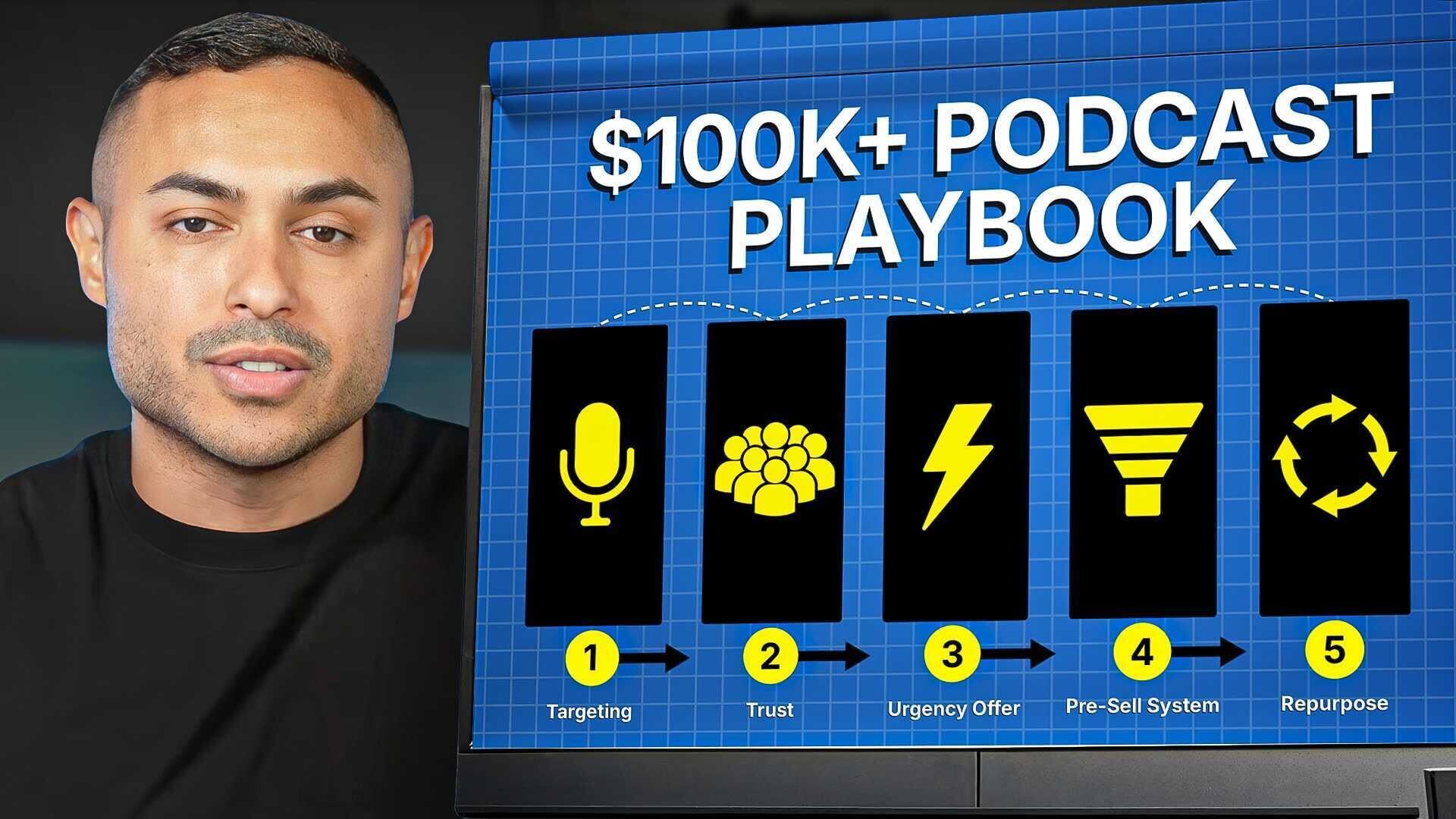
The difference between making zero dollars and making six figures from podcast appearances comes down to having five specific backend systems in place. This article breaks down the exact framework that helped one client generate over six figures from the podcasts we got him booked on, complete with full attribution tracking.
Why Most People Make Zero Dollars from Podcast Appearances
Let's be real about what's happening here. Most people treat podcast appearances like they're collecting Pokemon cards. They get booked on any show that will have them, show up unprepared, deliver a generic message, and send people to their website or LinkedIn profile.
Then they sit around wondering why nobody bought anything.
The biggest mistake people make is thinking that podcast marketing is about getting on as many shows as possible. Wrong. Podcast marketing is about getting on the RIGHT shows with the RIGHT message and the RIGHT backend systems to convert attention into revenue.
Here's what typically happens. Someone gets booked on a business podcast. They talk about their offer. They tell people to go check out their website. Maybe they mention a lead magnet. Then the episode goes live and... crickets. No leads. No calls booked. No revenue.
Why? Because they have no attribution system in place. They don't know if anyone even listened. They don't know which podcasts produced results. They have no way to track the data. So when I ask them "Did podcasts work for you?" they inevitably say "I don't know. I don't think so."
The reality is they have absolutely no idea if podcasts worked because they never set up a system to measure results in the first place.
The Five-System Framework That Generates Six-Figure Revenue from Podcasts
Before I break down each system, let me tell you about Patrick. When Patrick came to work with us, he was running a multi-million dollar company called Stacking Capital. What they do is simple. They get business owners access to funding at zero percent so these owners can scale their businesses faster.
Long story short, his business partners formed a coup. They took all his marketing assets, sales assets, everything. They left the company and started their own thing. Patrick was left starting from absolute zero.
About five months after he started working with us, he sent me a voice note. He told me the podcasts were producing incredible momentum. He was getting extra clients. But more importantly, people were showing up to sales calls already trusting him. They viewed him as the particular solution to their particular problem. They saw him as an authority.
Then he said something that really got my attention. He told me how the podcasts were dramatically affecting their paid advertising process. Their ads were converting better. Their sales team was using the podcast content in group chats with closers.
Patrick made over six figures directly from the podcasts we got him on. But here's what's even more important. He made way more money from how he deployed the content from those podcasts than from the actual shows themselves.
The five-system framework we used with Patrick is the same framework we use with every single one of our clients. Here's how it works.
System One: How to Get Booked on the RIGHT Podcasts for Your Ideal Client
The foundation of the entire operation comes down to one thing. Getting you in front of the right people. And when I say right people, I specifically mean two things.
Number one, getting you in front of people who are already interested in the end desire you help them accomplish. Not what you do, but what they ultimately want to achieve.
Here's where most companies screw this up. They have a shortsighted view of podcast marketing. For Patrick's case, they would think "Oh, we'll just get him on credit-based podcasts or capital-raising podcasts." But that completely misses the point.
Patrick doesn't help people get access to funding. That's what he does. What he actually helps people accomplish is scaling their business faster. The more capital you can stack, the faster you can scale. That's the end desire.
So we needed to ask ourselves: Based on Patrick's ideal client, what podcasts are going to get him in front of people who have that desired end result? People who want to scale their business faster?
We didn't get Patrick on a bunch of random entrepreneurship and business podcasts like most folks do because they're lazy and don't understand marketing at a high level. Instead, we looked at our network of thousands of podcasts and identified shows that would get him in front of sophisticated business owners.
Why sophisticated? Because we needed people who understood how getting access to capital at zero percent could be a tool they could leverage to scale faster. If we got Patrick in front of people looking to make their first five or ten thousand dollars a month, they wouldn't be able to conceptualize how access to capital at his level would help them.
Number two, we needed to make sure the audience had the financial capability and willingness to pay for his services. Because here's the thing. If we're getting you on podcasts but the audience doesn't have the money, it's not going to do anything for you.
That means we need to pair audience alignment with financial capability and willingness. The way we do that is simple. We study audience demographics, psychographics, income levels. We look at podcast topics and past guests. We go so in-depth that we can say with as much certainty as possible that these people are likely to be sophisticated business owners with the financial capability to pay for the offer.
At the end of system one, we're able to identify the perfect podcasts that Patrick needs to go on if he wants to get clients specifically for his business.
Why Sophisticated Audience Selection Beats Random Business Podcasts Every Time
This is where most people miss the boat completely. They don't do this audience selection work. They just get on a bunch of random business podcasts and hope it works out.
Instead, you need to think in reverse. Where are the people who have the end desire you help them achieve spending their time? How can you leverage the podcast host's audience to get in front of those people?
Here's why this matters so much. When you get on the right podcast, the trust that has been developed between the podcast host and their audience gets transferred onto you. This is called trust transfer, and it's one of the most powerful psychological principles in marketing.
The podcast host has spent months or years building trust with their audience. When they bring you on as a guest and endorse you (even implicitly by having you on the show), that trust transfers to you. The audience doesn't start from zero with you. They start from wherever their trust level is with the host.
But this only works if you're on the right show. If you're on a podcast where the audience doesn't care about the end result you deliver, trust transfer doesn't matter. They won't convert no matter how much they trust the host.
So the first part of the process is getting on the right podcasts that specifically get you in front of your ideal client by doing an extreme amount of due diligence on the shows you're targeting.
System Two: Maximize Audience Retention to Build Trust That Converts
Patrick said something in his message that stuck with me. He said "People show up to calls and view me as the particular solution to their particular problem."
What that tells me is the audience has an incredible amount of trust with Patrick. But the reason Patrick was able to develop so much trust wasn't just because of trust transfer from the host. It was because he got them to spend so much time with him on the podcast.
Patrick was able to leverage certain psychological principles and components that retained the audience's attention. This is where most people go wrong. They don't know the best practices to not just get somebody to click on the podcast, but more importantly to get them to stay until the very end.
Why Time Equals Trust in Podcast Marketing
Here's how we spell trust: T-I-M-E.
The more time we get people to spend with us on that podcast, the more trust they're going to have. And the more trust they have with us, the more likely they are to convert. That's why maximizing retention maximizes conversion.
Think about it this way. If someone listens to the first five minutes of your podcast interview and clicks away, they spent five minutes with you. If someone listens to the entire 60-minute episode, they spent 60 minutes with you. Who do you think trusts you more?
The person who spent 60 minutes with you has heard your story. They've heard your expertise. They've heard how you think about problems. They've heard you provide value. They've spent an hour in your presence. That builds massive trust.
Most people have never spent 60 consecutive minutes with their best prospects before they try to sell them. Podcasts give you that opportunity. But only if you keep them listening.
How to Keep Listeners Engaged from Start to Finish Using Psychological Principles
We worked with Patrick on everything. How to introduce yourself on a podcast using a specific method that immediately hooks the audience. How to answer questions in a way that draws contrast between everybody else in your market and you. How to craft an urgency-based offer and frame it in a way that positions you as the person they absolutely need to get the offer from.
Now here's where people get confused. Sometimes they'll say "Oh, you're going to teach me public speaking. I already know how to speak. I speak on stages."
Listen. We work with the highest-level speakers in the world. Les Brown. Brian Tracy. Just to name a few. And they implement these strategies as well because it's a different vehicle.
Speaking on a podcast is fundamentally different than speaking on a stage or giving a presentation. What we show you are all the best practices to maximize audience retention in this specific vehicle so you can convert at an even higher level.
These aren't generic public speaking tips. These are specific psychological principles that work in the podcast format. Things like pattern interrupts. Strategic storytelling. Contrast framing. Offer positioning. All designed to keep someone listening from start to finish.
System Three: Create an Urgency-Based Offer Exclusive to Podcast Audiences
Here's the biggest mistake people make on podcasts. They get to the end of the interview and they say things like "Go to my website if you want to learn more" or "Check out my LinkedIn" or "Go download my lead magnet."
In other words, they do not have an offer that gives people a compelling reason to take action right now in order to get that specific offer.
With Patrick, we looked at his business and created an offer that would do a few things.
Number one, when people heard it, they would know it was for them. There was no guesswork involved. That's where a lot of people mess up with offers. The offer is so big and broad and for everybody that it doesn't resonate with anybody.
We created an offer exclusively for podcasts that the audience literally could not find anywhere else on planet Earth. That in and of itself creates a sense of scarcity that prompts them to act now.
Number two, we described exactly who the offer was for. Now it's not only a scarce resource, but it's a valued resource by the person it's specifically designed to attract.
Then once we crafted the specific offer, we wrapped it all in the perfect framing. It's all in how you present your offer and how you leverage the power of language to present it in a way that creates an insatiable amount of desire in the audience.
Why Generic CTAs Kill Podcast Conversion Rates
Let me be real with you. If your call-to-action is "go to my website" or "download my free guide," you're leaving massive amounts of money on the table.
Why? Because those CTAs have zero urgency. There's no reason for someone to act now instead of later. And when there's no reason to act now, people don't act at all.
Think about what happens when someone hears "go to my website." They think "Okay, I'll check that out later." Then they forget. They never go. You lose the lead entirely.
Compare that to an urgency-based offer that's exclusive to that specific podcast audience. Now they're thinking "Wait, I can only get this from this specific show? And it's not available anywhere else? I need to act on this now before I lose the opportunity."
That's the difference between an offer that converts and a generic CTA that does nothing.
The key is creating something that has real scarcity, real value, and real specificity. When you combine those three elements with the right framing and language, you create what we call insatiable desire. People feel like they have to have it.
How to Frame Your Offer to Create Insatiable Desire in 60 Seconds
The framing of your offer is just as important as the offer itself. Maybe more important.
You can have the best offer in the world, but if you present it poorly, nobody will take action. On the flip side, you can have a decent offer and if you present it with the right psychological framing, people will jump on it immediately.
Here's what we helped Patrick do. We created specific scripting he could use on every podcast to deliver his offer in a way that communicated all the psychological components needed to create desire.
Things like scarcity ("This is only available to listeners of this specific show"). Things like exclusivity ("You can't find this anywhere else"). Things like specificity ("This is specifically for business owners doing at least $500K a year who want to scale to seven figures faster").
But we also taught him how to frame the offer in terms of what they get, why it matters, and what happens if they don't take action. That's the complete psychological formula that turns a decent offer into something people feel compelled to act on immediately.
System Four: Build Pre-Selling Systems That Turn Hot Leads into Booked Calls Fast
The fourth thing we did with Patrick was set up what we call pre-selling systems. And ultimately what this is about is how do we take the attention from the podcast and turn it into a booked call as quickly as possible.
Why? Because a podcast lead is the hottest they will ever be as soon as they're done listening to you on that podcast.
Why Podcast Leads Are Hottest Immediately After Listening
This is where most people screw it up completely. They'll set up some type of landing page, make people opt in, and then what happens? The thank you page says "Thanks for opting in. Go check your inbox."
Then they send the lead into some drip nurture email sequence they learned from reading DotCom Secrets. And by the way, if you're doing that, listen, I'm being a bit facetious here. But the reason you're doing it is simply because you haven't been exposed to a higher level that converts at an extremely higher rate.
Here's what we did with Patrick instead. Not only did we create a way for him to capture that attention and get those people the offer, but the very next step in the process was book a call. We did it in a way that leveraged the power of language and framed the call so they didn't look at it as a sales call. They looked at it as a way to help them implement the offer they just got access to.
Think about the psychology here. Someone just listened to 60 minutes of Patrick on a podcast. They trust him. They view him as an authority. They see him as the particular solution to their particular problem. They take action on his exclusive offer.
Now they land on a page that says "Book a call with our team so we can help you implement this and get you results faster." That doesn't feel like a sales call. That feels like the natural next step to getting what they want.
That's the power of proper framing and language.
How to Qualify Leads Before They Reach Your Calendar
But here's the other thing we did. We set up a method to disqualify and qualify leads before they ever reached Patrick's calendar.
Why? Because Patrick can't help everybody. His clients need to have a certain level of revenue and certain financial capability to even afford his services. So what we did was very simple.
We set up an easy qualification process where only qualified leads based on financial capability reached his booking calendar. The people who were disqualified never even saw the calendar.
This dramatically increased Patrick's close rate because he was only speaking to qualified prospects. Not only that, but qualified prospects who had already shown an extreme level of interest in what he does by spending 60 minutes listening to him on a podcast.
Patrick said it perfectly in his message. "People show up and they already trust me. They know we're the particular solution for their particular problem."
When you get a qualified person on a sales call who already spent 60 minutes with you, already trusts you, and already views you as the solution, it's what we call a laydown lead. All you have to do is tell them how much it costs and don't screw it up in order to close the deal.
System Five: Deploy Content Distribution Across All Marketing Channels
Now we get to the fifth part of the system. And in my opinion, this is the most important part of the equation.
Here's the reality. Not everybody who listens to you on the podcast the first time is going to buy something from you. But more importantly, you have a whole other market that doesn't even listen to podcasts.
If you don't understand the 7-11-4 principle that Google came out with a few years ago after doing incredible research, you're missing the biggest opportunity in podcast marketing.
The 7-11-4 Principle: Why People Need Seven Hours Across Eleven Touchpoints
What Google discovered was this. It takes people an average of seven hours of consuming your content across eleven different touchpoints across four different platforms in order to buy what you have.
Now of course, you're going to have 10 percent of people who don't need all that. They'll buy after just watching the podcast or consuming a little bit of content. But for most people, they require more information.
Why? Because more information reduces the level of perceived risk of buying your offer in their mind.
They're ultimately trying to answer one question: Who can I trust?
The reason they're consuming seven hours across eleven touchpoints across four platforms is because they're looking for who to trust. And the answer for who to trust comes down to consistency across your messaging.
When they see a Facebook ad, then go to Google, then go to ChatGPT, then go to Instagram, then go to LinkedIn, and they see consistency in your messaging across all those different platforms, they perceive you as an authority. They perceive you as someone they can trust and have a high level of certainty can deliver on the result you promise.
This is where content distribution becomes absolutely critical.
How to Turn One Podcast into Your Best Performing Paid Ads
What we helped Patrick do was create an entire content distribution system by leveraging nothing more than the podcasts he was appearing on.
I actually talked to Patrick this morning. One of the things he sent me in a message: "The podcasts you got me on really made the ads convert so much better this time around, I truly believe. And also, my sales team is using them for group chats with closers."
Let me break down what's happening here. Patrick's podcasts became his best performing ads. He took the content from those interviews and turned them into paid advertisements that converted at a much higher rate than his previous ads.
Why? Because now people were seeing him on a podcast (authority), hearing him provide value (trust), and then seeing an ad from him later (consistency). That combination is incredibly powerful.
But he also started using the podcasts as what we call trust assets prior to sales calls. Even if somebody came from an ad, Patrick's team would put the podcast in front of them before the call. By the time they showed up to the sales call, they'd already consumed 60 minutes of Patrick on a podcast.
They showed up well-framed. They showed up with certain beliefs already in place that are needed to ultimately buy.
Why Content Distribution Makes More Money Than the Podcast Itself
Patrick is making way more from these podcasts from how he's deploying the content than he did from the actual shows. Don't get me wrong, he made sales directly from the podcasts. But how he's leveraging them and using them as long-term assets is producing far greater results.
He created an entire content distribution system that's fueling all of his organic marketing, paid marketing, and his sales process.
Think about what this means. One podcast interview becomes:
Multiple social media posts across platforms
Email nurture sequences
Paid ad content that converts higher
Pre-call trust assets that frame prospects
Sales enablement content for the team
Long-term organic traffic from SEO
When you understand the power of content distribution across your organic and paid marketing as well as your sales process, it influences everything and makes everything work better.
You end up making more money from the podcast based on how you use the podcast after the podcast than when you were on the podcast.
The Four to Five Month Timeline: Setting Realistic Expectations for Podcast ROI
Here's the thing I need to be real with you about. It took Patrick four to five months to begin seeing these types of results.
Why? Because we had to schedule the podcasts. He had to go on the podcasts. Then they had to edit the episodes, throw them in the queue, and then publish them.
This isn't a short-term game. If you're somebody looking for something to get rich quick, this isn't for you.
But if you're somebody that's really looking to scale your business, develop trust at an incredible scale, and ultimately make all of your marketing and sales more profitable so you can experience higher margins, then this is a vehicle you want to leverage.
Because it's going to be the thing that allows you to build trust at scale. And trust at scale is what leads to businesses scaling faster than ever before.
Now here's the other reality. Patrick actually put in the work. He listened to what we told him to do and he implemented it. I don't know quite frankly if you will because Patrick's a very dedicated person.
But even if you do podcast marketing on your own or work with someone else, make sure you implement these five systems. Because if you don't, you're not going to make a profit from the podcasts you go on. And you're inevitably going to be like one of those people who say "It just didn't work out for me."
The framework works. The question is whether you'll actually implement it consistently over a four to five month period. Most people won't. That's why most people make zero dollars from podcast appearances while a small percentage make six figures or more.
The difference isn't the medium. The difference is the system and the execution.
Final Takeaway
Podcast marketing isn't about getting on as many shows as possible. It's about getting on the right shows, maximizing audience retention to build trust, delivering an urgency-based offer that creates desire, setting up pre-selling systems that convert hot leads fast, and deploying content distribution that makes everything in your business work better.
We did all of this with Patrick in a way where there was very clear attribution. He knew exactly which podcasts were producing what results down to the smallest detail. Most people have absolutely no way of tracking their data. They have no way of attributing results to podcasts. That's why so many people inevitably say "Podcasts just don't work."
We're very big on having clear data tracking and attribution. From how many podcasts we're getting clients on, how big they are, average audience size, all the way to how many leads and sales came from each and every single podcast.
If you implement this five-system framework, you can replicate similar results. Not saying you will, but at least now you know the exact system that produces six-figure revenue from podcast appearances instead of zero dollars.