
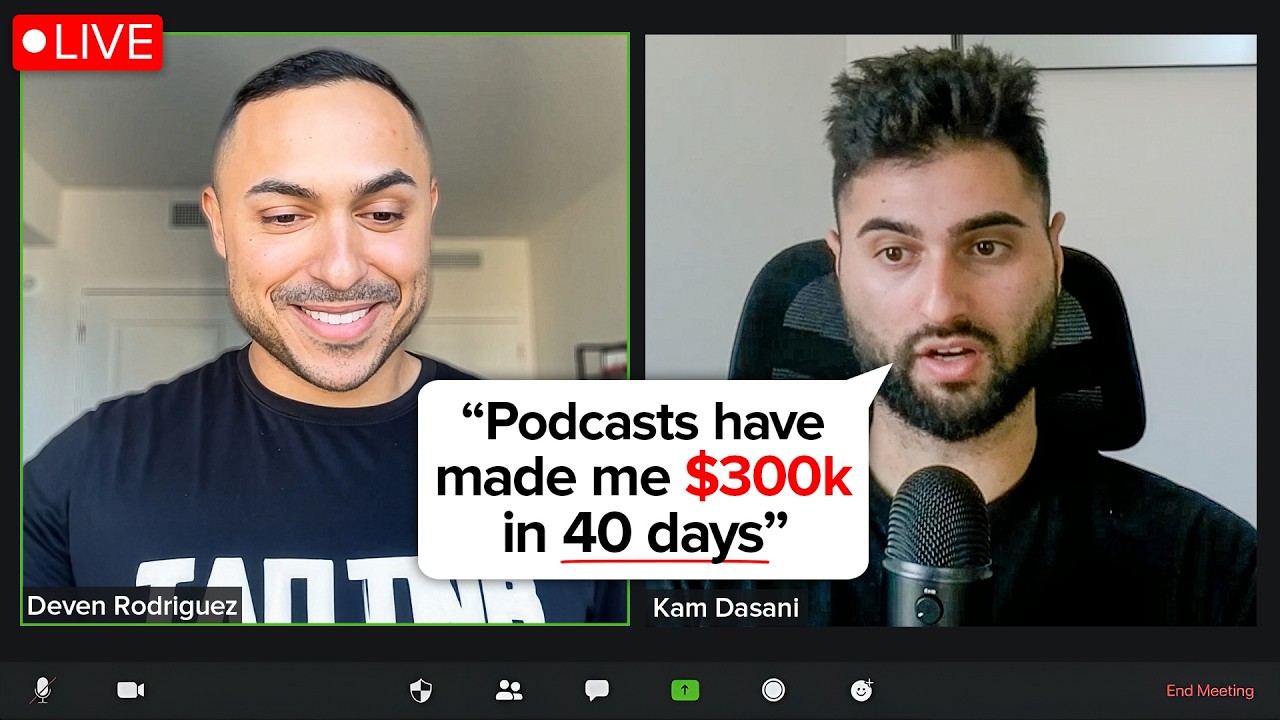
How to Generate $300K from Podcast Appearances in 40 Days Using Targeted Shows and Trust Transfer
Article Description: Most business owners go on podcast appearances and make zero dollars. This case study breaks down how one entrepreneur generated $300,000 in 40 days from 12 targeted podcast placements, achieved a 90% close rate on podcast leads, and turned his content problem into an unlimited clip machine.
TABLE OF CONTENTS:
Why Most Podcast Appearances Generate Zero Revenue for Business Owners
Why Podcast Lead Quality Crushes Paid Advertising Lead Quality
How Trust Transfer from Podcast Hosts Increases Close Rates to 90 Percent
Why Podcast Audiences Convert Faster Than Cold Traffic from Ads
How to Create Podcast Exclusive Offers That Drive Immediate Action
Why Picking the Right Podcast Shows Matters More Than Going on Many Shows
How Podcast Appearances Solve Your Content Creation Problem Forever
The 60000 View Reel Strategy Using Podcast Clips for Organic Growth
How Podcast Appearances Compound Over Time for Long Term Revenue
Why Podcast Marketing Is the Backup Plan That Becomes the Main Plan
OPENING SECTION:
Most business owners treat podcast appearances like a nice-to-have marketing activity. They go on a few shows, drop their website link, and hope something magically happens. Then they wonder why podcasts "don't work" for their business.
The reality is most people approach podcast marketing completely wrong. They chase big-name shows instead of targeted audiences. They wing their interviews instead of following a proven framework. They have no system to convert listeners into clients.
This case study changes everything. It documents how Kam Dasani, a trading education business owner, generated $300,000 in 40 days from podcast appearances after his Meta ad account got completely disabled. His close rate on podcast leads? 90 percent compared to 50 percent from ads. His business went from $80-100K per month to $250K per month using podcast marketing as his primary lead generation channel.
The difference between Kam's results and most podcast guests who make zero dollars comes down to three things: targeted show selection, trust transfer psychology, and a conversion system that turns listeners into booked calls. Here's exactly how it works.
Why Most Podcast Appearances Generate Zero Revenue for Business Owners
Podcast appearances fail for most business owners because they treat them like free publicity instead of a strategic client acquisition channel. They go on random shows, talk about random topics, and give a generic call to action at the end.
The fundamental problem is a lack of targeting and conversion systems. Most people think getting on any podcast is good exposure. Wrong. Very wrong. Getting on the wrong podcasts wastes time and delivers zero ROI.
Here's what typically happens: A business owner pitches themselves to 50 podcasts. They get booked on 10 shows with random audiences. They do the interviews, share them on social media, and wait for clients to magically appear. Nothing happens. They conclude that podcast marketing doesn't work.
The issue is they were never in front of their ideal clients. They were talking to audiences who had zero interest in their offer. It's the equivalent of running Facebook ads to the wrong targeting. The platform isn't broken. The strategy is broken.
Kam Dasani's situation proves this point perfectly. He was doing $80-100K per month from Meta ads. His marketing was solid. His sales process converted at 50 percent. Then his ad account got disabled with no warning and no way to recover it.
Without a backup lead generation channel, his business would have died. But because he had already started working with a targeted podcast strategy, he not only survived but thrived. His business jumped from $100K per month to $250K per month while his ads were completely offline. The podcast appearances didn't just replace his ad revenue. They multiplied it.
How Targeted Podcast Appearances Generated $300K in 40 Days
The $300,000 result from podcast appearances didn't happen by accident. It came from a specific strategy of getting on 12 targeted podcasts with audiences that matched Kam's ideal client profile perfectly.
Not all 12 shows produced equal results. A few of the podcasts drove massive influxes of leads and revenue. Shows like Entrepreneur DNA with Justin Colby and Fresh and Fit brought floods of qualified prospects straight to Kam's calendar. The remaining shows contributed to content creation, brand building, and middle-of-funnel awareness.
Here's the math that matters: December 7th to January 16th is 40 days. $300,000 in revenue divided by 40 days equals $7,500 per day in podcast-attributed revenue. That's not theoretical. That's directly tracked and measured.
The key insight is show selection. Going on 100 random podcasts would have produced worse results than going on 12 highly targeted ones. The audiences on Entrepreneur DNA and Fresh and Fit already trusted the hosts. They were entrepreneurs and traders who actively wanted what Kam was selling. The targeting was built into the show selection.
Compare this to Meta ads where you're constantly fighting the algorithm to find the right people. With targeted podcast appearances, the right people have already self-selected into an audience. They've subscribed to a show about exactly what you do. The targeting is done before you even open your mouth.
This is why Kam could generate $300K from podcast appearances while his brand new ad account (after the old one was disabled) still wasn't producing good results months later. The podcast strategy didn't need to "warm up" like a new ad account. It worked immediately because the targeting was already dialed in.
Why Podcast Lead Quality Crushes Paid Advertising Lead Quality
The difference between podcast leads and paid ad leads isn't just about quantity. It's about quality. And quality determines close rates, which determine revenue.
Kam's close rate from Meta ads was 50 percent. That's actually excellent for paid traffic. His marketing was strong. His VSLs were compelling. His sales team knew how to sell. But cold traffic from ads requires significant trust-building before someone is ready to buy.
His close rate from podcast leads? 90 percent. That's not a typo. Nine out of ten people who booked calls from podcast appearances ended up buying.
The reason is simple: Podcast listeners have already spent 30-60 minutes with you. They've heard your story. They understand your philosophy. They've experienced your personality. By the time they book a call, they've essentially decided to buy. The call is just a formality.
With paid ads, prospects have watched a 3-minute VSL and maybe scrolled your website. They're curious but not convinced. They still have objections. They still have doubts. The sales call has to do the heavy lifting of building trust from scratch.
Podcast leads show up pre-sold. They've already done their due diligence by listening to an hour-long interview. They know what you stand for. They know how you think. They've heard your best ideas explained in detail. The trust is already built before the first sales conversation happens.
This 90 percent vs 50 percent close rate difference means you need half as many leads from podcasts to generate the same revenue as ads. And those leads require less sales effort, fewer follow-up calls, and shorter sales cycles. The lead quality improvement compounds across every metric in your business.
How Trust Transfer from Podcast Hosts Increases Close Rates to 90 Percent
The psychological principle behind podcast marketing success is called trust transfer. When a podcast host interviews you, their audience's trust in the host transfers to you.
Think about how this works in reverse. If a podcast host had a guest who turned out to be a scammer, the audience would lose trust in the host for having bad judgment. They trusted the host to vet their guests and bring on legitimate people.
The flip side is equally powerful. When the host vouches for you by having you on their show, the audience assumes you must be credible. Why else would their trusted host give you a platform? This subconscious reasoning happens automatically in the listener's mind.
Kam explained it perfectly: "I'm in front of people that trust the person that is interviewing me."
This trust transfer is why podcast leads close at 90 percent. The audience doesn't see you as a stranger trying to sell them something. They see you as someone their trusted host has endorsed. The skepticism that normally exists with cold traffic simply isn't there.
Here's the psychology behind it: Humans are tribal creatures. We evolved to trust people who are accepted by our tribe. When a podcast host (tribal leader) brings someone into the conversation (tribal acceptance), the audience's brain automatically categorizes that person as trustworthy.
Paid ads can never replicate this dynamic. An ad is an interruption from a stranger. A podcast appearance is an introduction from a friend. The neurological response to each is completely different. One triggers skepticism. The other triggers trust.
The 12 Targeted Podcast Strategy That Outperformed Meta Ads
The podcast booking strategy that generated $300K wasn't about getting on as many shows as possible. It was about getting on 12 highly targeted podcasts with audiences that matched Kam's ideal client profile.
Here's the strategic breakdown of how this works. Out of 12 podcasts, a few will drive massive direct results. Shows like Entrepreneur DNA and Fresh and Fit had audiences packed with entrepreneurs and traders who were actively looking for what Kam offered. These shows drove immediate revenue.
The remaining podcasts served different purposes: content creation, brand building, and middle-of-funnel awareness. Every podcast appearance generates clips that can be repurposed across social media. Every appearance builds credibility and authority. Every appearance puts you in front of potential clients who might not buy today but will remember you later.
This is the multiplication effect of podcast marketing. One appearance creates dozens of content assets. Those assets continue working for months or years after the original interview. The initial 12 podcasts become an unlimited content library.
Compare this to Meta ads where you're paying for every single impression. When you stop spending, the leads stop coming. With podcast appearances, the content compounds. The work you do once continues to generate results forever.
Kam's ad account got disabled in November. As of January 16th, he still hadn't gotten good results from his new ad account. But his business was thriving because the podcast appearances kept generating leads and revenue without any additional ad spend.
Why Podcast Audiences Convert Faster Than Cold Traffic from Ads
When Kam offered a 14-day free trial to podcast audiences, something interesting happened. Prospects didn't even finish the trial before buying.
"Day one, day two, they're buying because they're looking at the results and they're like, 'No, no, no. We're ready.'"
This is the opposite of what happens with paid ad traffic. Cold prospects are skeptical. They want to test everything before committing. They use every minute of a free trial to evaluate whether the product is worth it.
Podcast listeners convert faster because the trust is already established. They've heard Kam speak for an hour. They've heard his philosophy on trading. They've heard his results and his approach. By the time they start the trial, they're already 90 percent convinced.
The free trial becomes a formality rather than an evaluation period. They sign up, see that the product is exactly what Kam described in the podcast, and immediately convert to paid.
This accelerated buying cycle has massive implications for cash flow and business growth. Instead of nurturing leads for weeks or months, podcast leads convert in days. Instead of complex follow-up sequences, the sale happens almost automatically.
Kam specifically noted that he wouldn't offer a free trial to ad traffic because "a lot of people just waste time on the trial. They don't take it seriously." But podcast audiences are different. They take the trial seriously because they already trust the source.
How to Create Podcast Exclusive Offers That Drive Immediate Action
One of the reasons Kam's podcast appearances converted so well was the offer structure. He created podcast-exclusive offers that gave listeners a compelling reason to take action immediately.
The offer for Entrepreneur DNA and Fresh and Fit was a free 14-day trial. This wasn't something he offered on ads. It was specifically designed for podcast audiences who already had high trust levels.
Here's why this works: Podcast listeners feel like they have a special relationship with the host and guests. They've spent hours with these people. When a guest offers something "exclusive" to the podcast audience, it feels like a VIP offer rather than a generic marketing pitch.
The key is matching the offer to the trust level. Ad traffic needs low-barrier offers because trust is low. Podcast traffic can handle higher-commitment offers because trust is high. Kam could offer a trial that required real engagement because he knew podcast listeners would actually use it.
The psychology of exclusivity also plays a role. When something is only available to a specific audience, it triggers scarcity and belonging. Listeners feel like they're part of an in-group that gets special access. This emotional trigger accelerates the buying decision.
If you're going on podcasts and just saying "visit my website" at the end, you're leaving massive money on the table. Create an offer specifically for that podcast's audience. Make it genuinely exclusive. Give them a reason to act now rather than later.
Why Picking the Right Podcast Shows Matters More Than Going on Many Shows
The quality vs. quantity debate in podcast marketing is settled. Quality wins every time.
Kam went on 12 targeted podcasts and generated $300K. Compare that to business owners who go on 50+ random podcasts and generate nothing. The difference is targeting.
"Picking the right shows is the first thing." This was Kam's observation after seeing the results firsthand. Not all podcasts are created equal. Some will blow you up. Others will contribute to content and brand building but won't drive direct revenue.
The mistake most people make is optimizing for the number of appearances rather than the quality of audiences. They brag about being on 100 podcasts without mentioning that none of those appearances generated clients.
Strategic show selection means identifying podcasts where:
The audience matches your ideal client profile
The host has genuine trust with their listeners
The topic alignment is obvious
The audience is actively looking for solutions like yours
When Kam went on Entrepreneur DNA, he was talking to entrepreneurs who trust Justin Colby. When he went on Fresh and Fit, he was talking to an audience that overlaps with traders and wealth-builders. The targeting was built into the show selection.
This is impossible to replicate with random podcast outreach. You can't pitch 50 shows and hope some of them have the right audience. You need to research, identify, and strategically target the exact shows where your ideal clients are listening.
How Podcast Appearances Solve Your Content Creation Problem Forever
Before podcasts, Kam struggled with content creation. He could write ad scripts and marketing copy, but organic content was a different challenge.
"I was really good at making ads, like writing scripts and copywriting and making good ads. I had trouble with content, meaning like I was like, what do I talk about today organically? What do I put on my page?"
This is a common problem for business owners who are great at paid marketing but struggle with organic presence. Coming up with daily content ideas is exhausting. Creating videos from scratch takes time. Maintaining consistency feels impossible.
Podcast appearances solve this problem completely. Every interview generates an unlimited amount of content clips. Kam's editor just goes through the podcasts, finds the best moments, and turns them into reels and posts.
"Now I'm putting out like two three reels a day on Instagram spread out." That's 60-90 pieces of content per month without Kam having to create anything new. The podcasts become the source material. The editing team extracts the value.
This is a fundamental shift in content strategy. Instead of sitting in front of a camera trying to think of what to say, you have conversations on podcasts where the content flows naturally. The clips are higher quality because they're part of a real conversation, not a scripted performance.
The content creation problem that limits most business owners simply disappears when podcast appearances become your content engine.
The 60000 View Reel Strategy Using Podcast Clips for Organic Growth
Before podcast clips, Kam's best-performing content was getting around 1,000 views. After implementing the podcast clip strategy, he had a reel hit 60,000 views.
That's a 60x improvement in reach from the exact same account with the exact same audience.
The difference is the content itself. Podcast clips outperform scripted content for several reasons.
First, the energy is different. When you're having a genuine conversation with a podcast host, you're more animated, more passionate, and more natural than when you're reading a script to a camera. Audiences can feel the difference.
Second, the context is different. A clip from a podcast interview carries implicit social proof. Someone important enough to be interviewed is probably worth listening to. This psychological trigger increases engagement.
Third, the content is different. Podcast conversations go deeper than typical social media content. You're sharing insights, stories, and frameworks that would feel too long for a scripted video. But extracted as clips, they hit perfectly.
Kam wasn't thinking about hooks and engagement when he was doing the podcast interviews. He was just sharing valuable information in a conversation. "I wasn't good at content. Why? Because I was thinking too hard about hooks and what to say."
The podcast format removes that overthinking. You just have a conversation, and the good clips emerge naturally. Your editor finds the moments that work, and you post them. The content creation becomes effortless.
Why Being Coachable Determines Your Podcast Appearance ROI
Here's the part most people don't want to hear: The results from podcast appearances depend on you, not just the strategy.
Kam generated $300K because he did the work. He showed up to coaching calls. He learned how to package his offer for podcast audiences. He implemented the systems. He followed the blueprint step by step.
"You actually listened to us and what we told you to do. You came to training. You allowed us to coach you and you put the effort in."
This is the two-way street that separates successful clients from unsuccessful ones. The strategy only works if you implement it correctly. The coaching only helps if you actually apply what you learn.
The ego problem is real. Many business owners think they already know how to do podcast appearances. They've been on shows before. They know how to talk. But there's a massive difference between doing podcast appearances and doing podcast appearances that convert.
Kam put his ego aside: "I don't know this game. So I can pretend like oh yeah I've made 100K a month from ads and I'm good at marketing. But Devon's playing the game at a different level than me and he knows this space very very specifically."
The way you speak on podcasts is different from how you speak on ads. The way you package your offer is different. The way you structure your stories is different. Learning these distinctions is what separates $300K results from zero-dollar results.
If you approach podcast marketing thinking you already know everything, you'll get the same results as everyone else who approaches it that way: nothing.
How Podcast Appearances Compound Over Time for Long Term Revenue
The immediate revenue from podcast appearances is impressive. But the long-term compounding effect is even more powerful.
"Imagine a year from now, I guarantee you people are still going to be joining from podcasts that happened a long time ago."
This is the multiplication effect of podcast marketing. Unlike ads that stop working the moment you stop paying, podcast appearances continue generating leads indefinitely. The episodes stay live. New listeners discover them. The content keeps working.
Kam's success on certain shows is also opening doors to bigger shows at discounted rates. When you can prove you performed well on one podcast (drove engagement, generated positive feedback, were a great guest), other hosts want you on their shows. Success compounds into more success.
The content repurposing also compounds. Those podcast clips that are getting 60,000 views? They're building an organic audience that will convert for months and years. The brand authority built through multiple podcast appearances compounds into easier sales conversations and higher close rates.
Compare this to the paid advertising treadmill. You spend $10K on ads this month, and you get leads this month. Next month, you need to spend another $10K to get more leads. The spending never stops because the results don't compound.
Podcast appearances are the opposite. You do the work once, and the results compound forever. The same 12 podcasts Kam did will likely generate another $300K+ over the next 12 months without any additional effort.
Why Podcast Marketing Is the Backup Plan That Becomes the Main Plan
Kam originally started podcast marketing as a backup channel. He was doing well with Meta ads but knew he needed diversification. Then his ad account got disabled, and the backup plan became the main plan overnight.
"You saved my entire business."
This isn't an exaggeration. Without the podcast channel, Kam would have gone from $100K per month to near zero while trying to rebuild his ad account. Instead, his business grew to $250K per month.
The lesson is clear: Relying on a single lead generation channel is dangerous. Ad accounts get disabled. Algorithms change. Costs increase. What works today might not work tomorrow.
Podcast marketing provides platform independence. You're not at the mercy of Meta's policies or Google's algorithm changes. You're building relationships with podcast hosts and their audiences. Those relationships don't get "disabled" without warning.
Here's the irony of Kam's situation: His new ad account (after the old one was disabled) still isn't producing good results as of January 16th. None of that data from his old account transferred over. He's essentially starting from scratch with paid advertising.
But his podcast appearances are generating more revenue than his ads ever did. The "backup plan" turned out to be a better primary strategy than the original plan.
This should make every business owner question their current marketing mix. If your ad account got disabled tomorrow, what would happen to your business? If you don't have a good answer, you might want to start building a podcast channel now, while you still have the luxury of time.
CLOSING SECTION:
Generating $300K from podcast appearances in 40 days isn't magic. It's the result of targeted show selection, trust transfer psychology, proper offer packaging, and a willingness to be coached on how to maximize every opportunity.
The numbers from this case study speak for themselves: $300,000 in 40 days. A 90% close rate compared to 50% from ads. Business growth from $100K to $250K per month. A 60,000-view reel from podcast clips. All from 12 strategically selected podcast appearances.
Most importantly, podcast marketing provides something paid advertising can never offer: compounding returns and platform independence. The work you do once continues to generate results forever. And no algorithm change or account suspension can take that away from you.