
How to Craft a Podcast Call to Action That Converts Listeners Into Clients Using a 5-Chunk Scripting Framework
Article Description: Most business owners go on podcasts and deliver a podcast call to action that sounds like everyone else, sending listeners to a website or social media page that generates zero clients. This article breaks down the exact 5-chunk scripting framework that frames your offer so powerfully that listeners feel an insatiable desire to take action immediately.
TABLE OF CONTENTS:
Why Most Podcast Call to Action Attempts Sound Identical and Generate Zero Revenue
How a Weak Podcast CTA Costs You More Than You Think in Lost Clients
Why Your Podcast Call to Action Needs the Same Rigor as a Paid Ad Funnel
How to Use a Reciprocity Frame to Set Up Your Podcast Call to Action Before the Episode Ends
How to Pre-Frame Your Podcast Offer With the Host Before Recording Even Starts
Why Audience Qualification Makes Your Podcast Call to Action Convert Higher Quality Leads
How to Describe Your First Offer Component Using the Podcast Call to Action Without Framework
Why the Change the Most by Changing the Least Principle Makes Your Podcast CTA Irresistible
Why B2B and B2C Podcast Call to Action Scripts Require Different Exclusivity Approaches
How to Deliver the Final Podcast Call to Action Using Scarcity and a Dedicated Landing Page
Why Every Podcast Call to Action Needs Its Own Landing Page for Attribution Tracking
How to Practice and Refine Your Podcast Call to Action Until It Converts Consistently
OPENING SECTION:
A podcast call to action is the single most important factor that determines whether you actually get clients from the podcasts you appear on. Most business owners invest an hour of their time on a show, have a great conversation, and then completely blow the one moment that matters most.
What do they say? "Go visit my website." "Follow me on Instagram." "Book a call if you're interested." And then they wonder why podcast appearances generate zero revenue. The problem is not the podcast. The problem is the framing. The way you present your offer in the final minutes of that interview is the difference between walking away with nothing and walking away with a pipeline of qualified, motivated leads.
The fix is not complicated, but it does require a specific approach. There is a 5-chunk scripting framework designed to wrap your offer in language that increases perceived value, creates urgency, and gives listeners a compelling reason to act right now rather than "maybe later." This article breaks down every chunk with exact scripting examples for both B2B and B2C businesses so you can steal the framework and start using it on your next appearance.
Why Most Podcast Call to Action Attempts Sound Identical and Generate Zero Revenue
The average podcast call to action sounds exactly like every other guest who has ever appeared on that show. "Go to my website." "Check out my Instagram." "Feel free to book a call." These phrases have become so generic that listeners tune them out completely.
The core problem is there is no compelling reason to act right now. There is no urgency. There is no exclusivity. There is nothing that separates what you just said from what the last 50 guests said on that same show. And when your CTA sounds like everyone else, you get the same results as everyone else. Which is nothing.
Here is what makes this even more frustrating. The business owner sitting across from that podcast host just spent an hour building trust, sharing expertise, and genuinely connecting with the audience. That audience is warm. They are engaged. They are interested. And then in the final two minutes, all of that momentum gets wasted because the podcast guest call to action was an afterthought rather than a carefully crafted conversion mechanism.
The reality is most people have never been taught how to deliver a podcast CTA that actually converts. They assume that showing up is enough. That the content speaks for itself. That people will somehow find their way to becoming a client. But attention without a system to capture it is just entertainment. And entertainment does not pay the bills.
How a Weak Podcast CTA Costs You More Than You Think in Lost Clients
The real cost of a weak podcast call to action is not just the clients you did not get. It is the clients you will never know you lost. There is no tracking. There is no attribution. There is no data to tell you that 200 people heard your interview, 50 were interested, and zero took action because your CTA gave them nothing to act on.
Think about it this way. If you run paid ads on Facebook and you do not give people a clear next step, you would never expect to make money. You would never run an ad that says "go check out my website if you feel like it" and then wonder why nobody converted. You would never spend money on ads without a direct call to action and a funnel behind it. But that is exactly what most people do on podcasts.
The difference is that with ads, you see the data. You see the click-through rate. You see the cost per lead. You see the conversion rate. With a podcast, if your podcast CTA is weak, you get zero feedback. You just walk away thinking "podcasts don't work for me" when the truth is your call to action did not work for you.
Every podcast appearance where you deliver a generic CTA is an hour of your time that you cannot get back. And the opportunity cost compounds. If you appear on 20 podcasts over six months and your call to action converts at close to zero percent because it is not dialed in, that is 20 hours of lost potential revenue. That math gets ugly fast.
Why Your Podcast Call to Action Needs the Same Rigor as a Paid Ad Funnel
A podcast call to action deserves the same level of strategic thinking that goes into every other part of your marketing. When you build a paid ad funnel, you obsess over the headline, the hook, the offer, the landing page, the follow-up sequence. Every element is tested, refined, and optimized. But when it comes to podcast appearances, most business owners wing it.
The audience listening to you on a podcast is arguably the warmest lead you will ever get. They just spent 30 to 60 minutes consuming your content. They heard your stories. They connected with your perspective. They trust you. In marketing terms, that level of engagement is almost impossible to replicate through any other channel. A cold ad gets maybe 3 seconds of attention. A podcast gets 30 to 60 minutes.
So why would you treat the conversion mechanism for your highest-trust channel with less care than you treat a Facebook ad? The answer is most people simply have not thought about it that way. They see podcasts as "content" or "exposure" rather than what they actually are, which is a lead generation channel that requires the same backend systems as any other revenue-driving activity.
When you start treating your podcast offer scripting with the same rigor as a paid funnel, everything changes. You craft the language. You test the framing. You build dedicated landing pages. You track the data. And suddenly, podcast appearances go from "nice exposure" to a predictable, measurable source of qualified leads and revenue.
How to Use a Reciprocity Frame to Set Up Your Podcast Call to Action Before the Episode Ends
The first chunk of a high-converting podcast call to action is the reciprocity frame. This is the foundation that separates you from every other guest who has ever appeared on that show. Instead of just launching into your offer when the host asks where people can find you, you set the stage by framing WHY you created this offer in the first place.
Here is the exact scripting. When the host opens the door for you to share your offer, you say something like: "One of the things that I really admire about you is that you are constantly overdelivering for your audience. And that honestly inspired me to want to do the same."
Why does this work? Because you are activating the reciprocity principle, one of the most powerful psychological triggers in human behavior. Reciprocity is the deep-seated social norm that when someone gives us something, we feel compelled to give something back. By framing your offer as a GIFT inspired by the host's generosity, you are doing two things simultaneously.
First, you are making the podcast host feel special. You are complimenting their work in a way that is specific and genuine. This makes them more likely to enthusiastically support your offer to their audience. Second, you are framing your offer as an act of generosity rather than a sales pitch. The audience hears "I created this for you because your host is awesome" instead of "buy my stuff." That framing shift changes everything about how the offer is received.
The reciprocity frame also creates a subconscious obligation in the listener. When they hear that you put something together specifically for them, specifically because of this show, their brain registers that as a gift. And gifts trigger a desire to reciprocate, which in this case means taking action on what you are offering.
How to Pre-Frame Your Podcast Offer With the Host Before Recording Even Starts
A critical step that most people miss when preparing their podcast call to action happens before the recording even begins. You want to communicate to the host that you have something to give their audience so that when the time comes, the host does not just ask "where can people follow you" but instead says "you mentioned you have something for the audience, tell us about it."
Here is exactly what to say before the episode starts. "Hey, one last thing before we get going. I created something exclusively for your audience as my way of reciprocating what you do for them. I have listened to a few of your episodes and you are always overdelivering for your listeners. That really inspired me. So if you are open to it, would you be opposed to me sharing something I put together specifically for your audience at the end of the episode as a thank you?"
They will always say yes. And now instead of a generic "where can people find you" moment at the end, you have a warm, enthusiastic introduction to your podcast exclusive offer. The host becomes your partner in delivering the CTA rather than just a moderator wrapping up the show.
This pre-framing technique also does something powerful psychologically. It sets up the host to actively promote your offer. They now feel invested in making sure their audience hears about it because they agreed to it. They may even build anticipation during the episode by saying something like "and stick around because our guest has something special for you at the end." That kind of podcast host relationship building turns a standard interview into a conversion event.
Why Audience Qualification Makes Your Podcast Call to Action Convert Higher Quality Leads
The second chunk of the podcast call to action framework is audience qualification. This is the step most people skip entirely, and it is the step that determines whether you get flooded with tire-kickers or attract genuinely qualified leads who are ready to take action.
Before you ever describe what you have to offer, you need to describe WHO it is for. You need to paint such a specific picture of your ideal listener that the right people feel like you are speaking directly to them and the wrong people self-select out.
Here is what this sounds like in practice for a B2C offer. "If you are a perimenopausal woman between 35 and 50, and you feel like no matter what you try, nothing is working. You want desperately to get back to the body you had in your early 20s. You have tried the 1,200 calorie diets. You have tried living in the gym for 2 hours a day. And nothing seems to stick. What you actually need is a step-by-step blueprint designed for YOUR specific body rather than another cookie-cutter system."
Here is what it sounds like for a B2B podcast CTA. "If you are a VP of Marketing or CMO, and right now you want nothing more than to scale your paid ads profitably, but every time you press on the gas, your costs rise, your margin shrinks, and you end up stuck and frustrated."
Why does audience qualification matter so much? Because it activates what psychologists call the "that's me" response. When a listener hears their exact situation described back to them, their exact frustrations, their exact desires, their exact failed attempts, something clicks. They feel understood. And people take action on things and people that make them feel understood. This is not just marketing theory. It is a fundamental principle of human behavior. We are drawn to people who "get" us.
The other benefit is practical. Things that are for everybody are for nobody. When you qualify the audience, you filter out people who would waste your time and attract people who are genuinely a fit. The result is fewer but higher quality leads that are far more likely to convert.
How to Describe Your First Offer Component Using the Podcast Call to Action Without Framework
The third chunk of the podcast call to action is where you describe the first component of your offer. This is where most people just say "I am going to give you my guide" and leave it at that. But the way you describe this component is what creates desire. And desire comes from a specific framing technique.
The key is to describe what your offer will help them achieve WITHOUT doing the things they desperately hate. This is the "without" framework, and it is one of the most powerful positioning tools in marketing.
For a B2C podcast offer, it sounds like this: "The first thing I have for you is what I call my Perimenopausal Grocery Guide. I am literally going to show you the exact foods you need to be eating right now that will help you lose weight without decreasing your caloric intake to starvation levels or living in the gym for 8 hours a day."
For a B2B podcast CTA, it sounds like this: "I am going to give you my Ad Optimization Playbook where I show you the exact step-by-step process to scale your ads profitably without living in your ads manager for 6 hours a day or constantly tweaking little things that do not move the needle."
Do you see the difference? You are not just describing what the resource is. You are describing the RESULT it delivers and the PAIN it eliminates. This framing creates contrast between your solution and everything else they have tried. Everything else required sacrifice, suffering, and frustration. Your solution gets them the same result (or better) without the pain they associate with the process.
A mentor once said something that captures this perfectly: "You need to help people change the most by changing the least." That principle is the foundation of this entire chunk. Your podcast offer framing should position your solution as the path of least resistance to the result they want most. When you nail this, the desire to grab your offer becomes almost automatic.
Why the Change the Most by Changing the Least Principle Makes Your Podcast CTA Irresistible
The psychological principle behind the "without" framework in your podcast call to action goes deeper than most people realize. It taps into a fundamental truth about human decision-making. People do not just evaluate an offer based on the benefits. They evaluate it based on the perceived cost of getting those benefits.
Every solution your listener has tried before came with a cost. The diet required starving themselves. The ad strategy required spending 6 hours in the dashboard. The coaching program required a complete lifestyle overhaul. Your listener's brain has created a strong association between "getting results" and "suffering through a painful process."
When you describe your offer using the "without" framework, you are breaking that association. You are telling their brain: this time is different. You can get the result without the pain. And that creates what psychologists call a perceived value gap. The value of the outcome stays the same, but the perceived cost drops dramatically. When value stays high and cost drops low, desire skyrockets.
This is also why specificity matters so much. Saying "without the hard stuff" is vague and unconvincing. But saying "without eating 1,200 calories a day or living in the gym" is specific enough that the listener immediately connects it to their own experience. They have DONE those things. They KNOW that pain. And hearing that your solution eliminates that specific pain creates an emotional response that generic language never could.
The bottom line for your podcast CTA scripting: Always describe your first component in terms of the result it delivers AND the specific pains it eliminates. This is what separates a forgettable offer from one that makes listeners think "I need that right now."
How to Use Exclusivity Framing to Make Your Second Offer Component Feel Priceless on a Podcast Call to Action
The fourth chunk of the podcast call to action framework is where you introduce the second component of your offer. And this is where the energy shifts. If component one creates desire, component two creates urgency. The mechanism is exclusivity framing.
Here is the exact language. "The second thing I have for you is something I have never given away for free, ever. This is something I truly reserve for my highest-level clients. And if you are skeptical of that because you have heard gurus say that before, I dare you to go look it up. Google it. Check my website. Try to find it. You will not, because I genuinely do safeguard this for my paying clients."
Why is this so powerful? Because it activates multiple psychological triggers at once. First, exclusivity. When people believe something is rare or restricted, its perceived value increases dramatically. This is the scarcity principle at work. Your brain assigns more value to things that are hard to get.
Second, the "go look it up, I dare you" language is a credibility amplifier. Most people who claim something is exclusive are bluffing. By actively challenging the listener to verify your claim, you flip the dynamic. You are not asking them to trust you. You are inviting them to test you. And that confidence signals authenticity in a market full of empty promises.
For a B2C podcast exclusive offer, you then describe the second component: "This is my Perimenopausal Weight Loss Protocol. The exact step-by-step nutritional framework, exercise program, and supplemental plan that my paying clients use to get back to the body they want. I am giving this to you for free today because of how much this show has inspired me."
For a B2B podcast offer, you describe it as: "This is our Ad Optimization Audit. We are going to sit down with your team, go through your numbers, your constraints, your specific situation, and build a customized framework that shows you exactly what holes to plug so you can scale profitably."
The combination of exclusivity language plus a genuinely valuable second component is what makes people think "I cannot believe they are offering this." That feeling is the tipping point between "maybe I will check this out later" and "I need to grab this right now."
Why B2B and B2C Podcast Call to Action Scripts Require Different Exclusivity Approaches
While the podcast call to action framework works for both B2B and B2C businesses, there is one important distinction in how you handle exclusivity framing for the second component. Getting this wrong can actually hurt your conversion rate.
For B2B offers, you CAN mention pricing. Saying "I typically charge my clients a $10K per month retainer for this information, but I am going to give it to you for free" works in a B2B context. Why? Because B2B buyers are accustomed to paying for solutions. A dollar amount attached to your offer increases perceived value because it creates a concrete anchor. They think: "This person charges $10K for this and I am getting it for free. That is a no-brainer."
For B2C podcast offers, do NOT mention pricing. If you help perimenopausal women lose weight, or you are in a business opportunity space, or you help people with trading, telling them "I charge $6,000 for this" does not increase desire. It can actually create resistance. B2C audiences are more motivated by exclusivity and emotional outcomes than by dollar anchors.
In the B2C space, what works is pure exclusivity language. "This is something I have only ever given to my highest-level clients." "You literally cannot find this anywhere else." "I created this just for this audience." The perceived value comes from the scarcity and the emotional connection, not from a price tag.
This distinction is subtle but it matters. The core podcast CTA scripting stays the same across both. The reciprocity frame, the audience qualification, the "without" framework, the exclusivity setup. All of that is identical. The only thing that changes is whether you anchor the value with a dollar amount (B2B) or pure exclusivity language (B2C).
How to Deliver the Final Podcast Call to Action Using Scarcity and a Dedicated Landing Page
The fifth and final chunk of the podcast call to action framework is where you actually tell people how to get the offer. This is the moment everything has been building toward. And the language you use here is just as important as everything that came before it.
Here is the exact scripting. "So as I mentioned, I created this exclusively for everyone listening right now. You cannot find this anywhere else. I actually built a specific page just for this audience to get access. And I have one ask. Please do not share this with anyone else. I created this just for the people tuning into this show as my way of saying thank you."
Why does the "please do not share this" language work? Because people want what they cannot have. This is reactance theory in action. When you tell someone that something is restricted or limited, their desire for that thing increases. By asking them not to share it, you are paradoxically making it feel more valuable and more urgent.
Then you deliver the actual URL: "If you want access, just go to YourDomain.com/PodcastName." And then you repeat it. "So once again, if you want the Grocery Guide and the Weight Loss Protocol, just head to YourDomain.com/PodcastName and you can grab it right on that page."
Two critical tactical notes here. First, make sure your domain is clean and easy to spell. If your URL is complicated or hard to remember, people will not type it in. If your current domain is not clean, go get a new one specifically for this purpose. Second, use the name of the podcast or the host as the URL slug, not a generic path. This is what enables attribution tracking so you know exactly which shows are driving leads and which are not.
The repetition at the end is intentional. You name the two components, you give the URL, and you say it again. Repetition increases recall. A listener who hears the URL once might forget it. A listener who hears it twice with the offer components named alongside it is far more likely to actually go get it.
Why Every Podcast Call to Action Needs Its Own Landing Page for Attribution Tracking
One of the most overlooked elements of a podcast call to action strategy is tracking. Most business owners have no idea which podcasts are actually generating results and which are a waste of time. And the reason is simple. They send everyone to the same generic page.
When every podcast has its own dedicated landing page, you unlock the ability to see exactly how many leads came from each show. You can track opt-ins, applications, booked calls, and revenue down to the specific episode. This turns podcast marketing from a guessing game into a data-driven acquisition channel.
Here is how the structure works. Your URL format should be YourDomain.com/PodcastName or YourDomain.com/HostName. Each page is identical in design and offer, but the unique URL lets your analytics tell you exactly where traffic is coming from. This attribution tracking is the difference between knowing that podcasts work and knowing WHICH podcasts work.
Without dedicated pages, you are flying blind. You might appear on 15 shows in a quarter, see some leads come in, and have no way to connect those leads to specific episodes. That means you cannot double down on what is working or cut what is not. You are making decisions based on feelings instead of data. And feelings are a terrible marketing strategy.
The setup is simple. Create a template landing page once. Then duplicate it for each podcast and change only the URL slug. The effort is minimal. The insight is massive. And it is the thing that lets you treat your podcast lead generation efforts with the same rigor and accountability as any other marketing channel.
How to Practice and Refine Your Podcast Call to Action Until It Converts Consistently
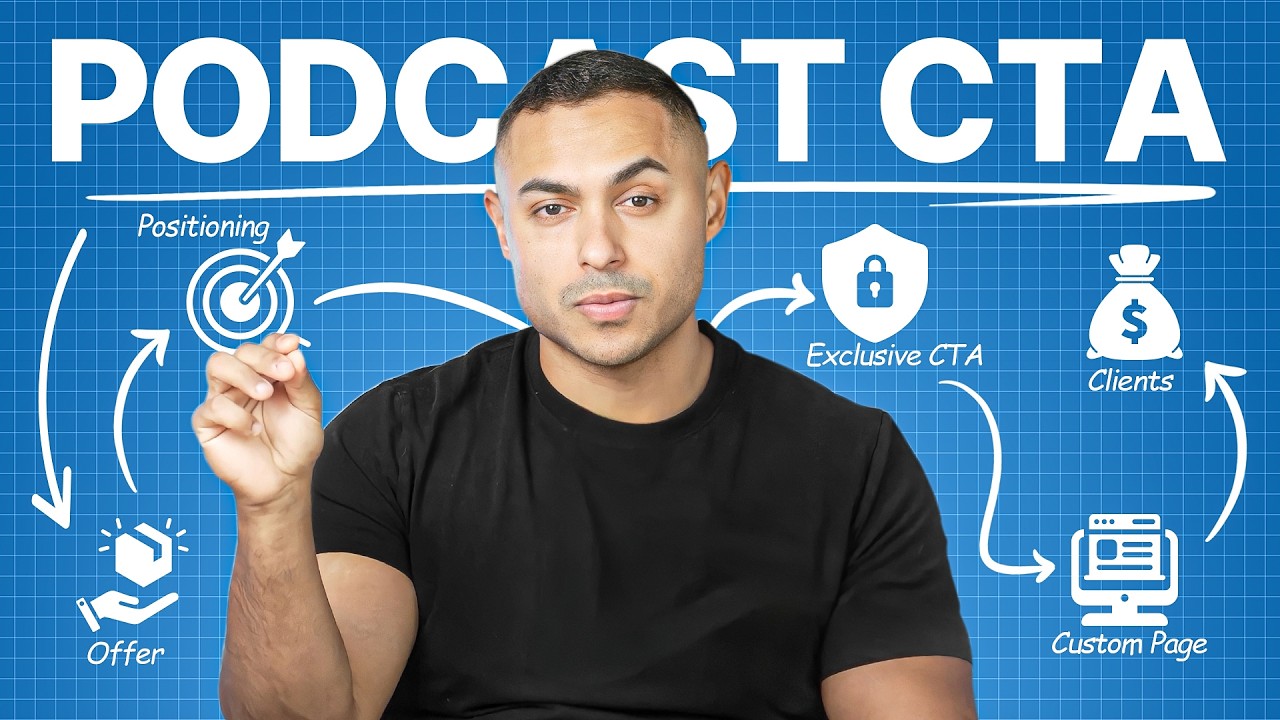
The podcast call to action framework covered in this article has five chunks: reciprocity framing, audience qualification, describing component one with the "without" framework, describing component two with exclusivity framing, and delivering the final CTA with scarcity and a dedicated landing page. Together, these chunks create an experience for the listener that is dramatically different from the generic "go to my website" that most guests deliver.
It might feel like a lot when you first read through it. The scripting, the framing, the psychological principles behind each chunk. But like any skill, it gets easier and more natural with practice. The business owners who consistently convert listeners into clients from their podcast appearances are not winging it. They have practiced their CTA until it flows as naturally as the rest of the conversation.
The key is to practice each chunk individually first, then string them together. Record yourself delivering the full CTA. Listen back. Does it sound natural or forced? Does the reciprocity frame feel genuine? Does the audience qualification describe your ideal client specifically enough that they would say "that is exactly me"? Is the exclusivity language believable?
Then test it on actual shows. Track the results using your dedicated landing pages. If one podcast generates 30 leads and another generates zero, look at the difference. Was the audience a better fit? Did you deliver the CTA differently? Was the host more supportive of the offer? The data will tell you what to adjust.
The framework works. But it only works if you actually use it. Do not let this be another piece of content that you consume and do nothing with. Take the scripting, adapt it to your business, practice it until it feels like second nature, and start deploying it on every single podcast appearance.