
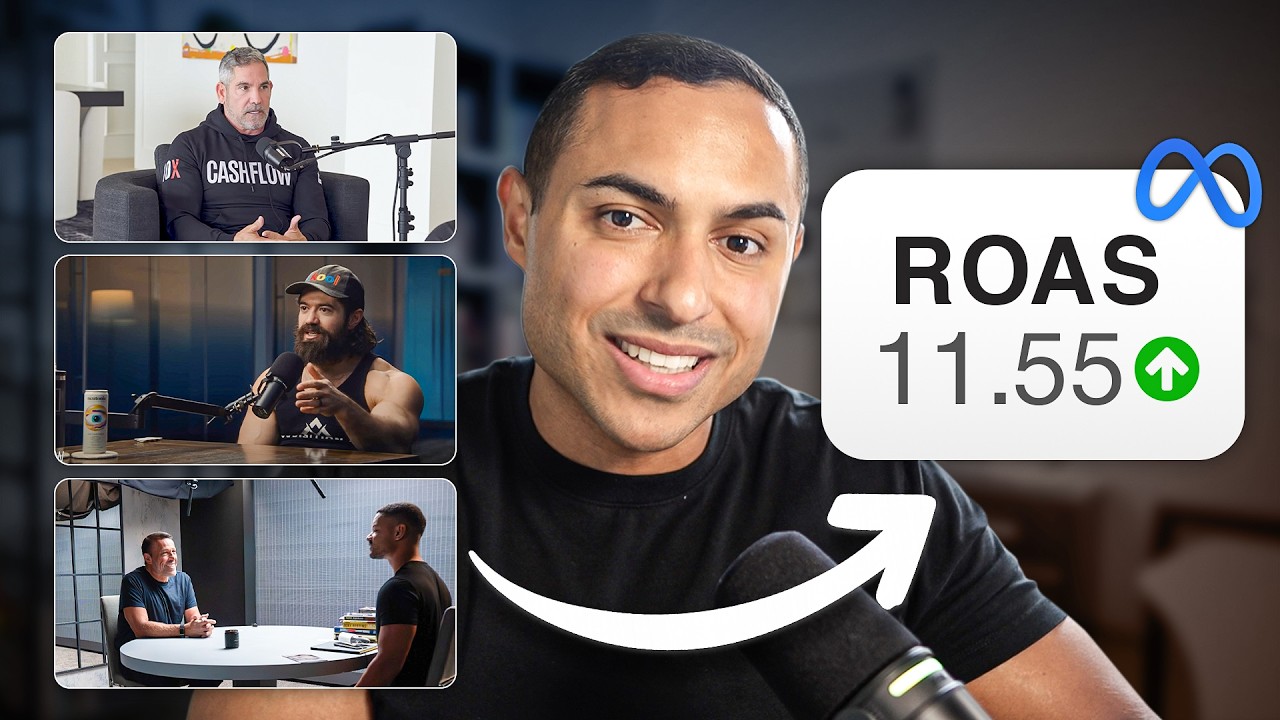
How to Make Paid Advertising More Profitable Using Podcast Guest Appearances and Three Proven Systems
Article Description: Most business owners running paid ads are watching their costs rise and their close rates fall while doing everything "right." Here's how podcast guest appearances fix the root cause of every expensive problem inside your paid advertising and sales process.
TABLE OF CONTENTS:
Why Paid Advertising Gets Less Profitable Every Year and What Is Actually Causing It
How Podcast Guest Appearances Trigger Familiarity Bias to Improve Every Paid Ad Metric
Why Familiarity Breeds Trust and What That Means for Click-Through Rates and Cost Per Lead
Why Trust Equals Time and How Podcast Content Closes the Gap Before the Sales Call
How Sales Reps Can Use Podcast Content to Manually Pre-Sell Prospects Before Every Call
How to Use Podcast Guest Appearances as Paid Ad Creative to Lower Cost Per Booked Call
Why Organic Podcast Content Outperforms Traditional Ad Creative in Today's Paid Ad Market
How to Build a Three-Layer Podcast Retargeting Campaign That Blitzes Prospects Before the Sales Call
The Short Form Blitz Strategy for Podcast Guest Appearances That Increases Show Rate and Close Rate
he Long Form and Segment Retargeting Strategy That Turns One Podcast Into Dozens of Ad Assets
Why Ad Creative Fatigue Makes Podcast Guest Appearances the Most Valuable Content Asset You Have
OPENING SECTION:
Podcast guest appearances are not a PR strategy. They are not a vanity play. And they are definitely not something you do just to say you've been featured on a few shows.
For business owners running paid ads to acquire clients, getting booked on the top-ranked podcasts in your niche is the single highest-leverage move you can make right now to bring your ad costs down and your profits up. Not by tweaking your funnel. Not by hiring a new media buyer. By doing something most of your competitors have not connected to their paid advertising at all.
Here is the reality: Your ads are getting more expensive. Your prospects are more skeptical. Your show rates are dropping. Your close rates are falling. And the harder you push on the same paid ad levers, the worse the numbers get. There is a reason for all of that, and it has nothing to do with your offer or your funnel. It has everything to do with trust.
This article breaks down exactly how podcast guest appearances solve the trust problem at every stage of your paid advertising and sales process, using three specific systems that work whether you are running call funnels, webinar funnels, or challenge funnels.
Why Paid Advertising Gets Less Profitable Every Year and What Is Actually Causing It
Paid advertising used to be simple. You ran an ad, people clicked, and a solid percentage bought. Back in 2020 and 2021, you could throw money at Meta and watch the revenue roll in. Your return on ad spend was strong, your cost per booked call was low, and scaling felt almost effortless.
That world is gone.
Here is what changed: The marketplace got crowded. More competitors entered. More offers started looking alike. More "gurus" promised results and delivered nothing. And your prospects, the very people you are paying to reach with every ad you run, got burned. Badly. Repeatedly.
So now when they see your ad, they do not see an opportunity. They see another promise from another stranger. And their brain says: skip it.
This is what marketers call the trust recession. Trust in paid advertising has dropped dramatically compared to just five years ago. People are more skeptical, more guarded, and more likely to scroll past an ad even when the offer is legitimately good and the targeting is perfect.
The result shows up in your numbers. Link click-through rates are lower than they have ever been. Cost per lead is up. Cost per booked call is up. Show rates are dropping because people book calls and then talk themselves out of showing up. Close rates are falling because even the prospects who do show up arrive cold, skeptical, and guarded. They tell your sales team things like "let me think about it" or "give me 24 hours," and then they disappear.
None of that is a funnel problem. It is a trust problem. And you cannot fix a trust problem by optimizing your ad copy.
The fix is establishing trust before your prospect ever sees your ad. That is exactly what podcast guest appearances do.
How Podcast Guest Appearances Trigger Familiarity Bias to Improve Every Paid Ad Metric
Podcast guest appearances work on paid advertising because of a well-documented psychological principle called familiarity bias. The concept is simple: people are more likely to take action on things they are already familiar with.
Your brain is wired to associate familiarity with safety. Humans evolved in small tribes where strangers were potential threats and familiar faces were safe. That hardwiring does not turn off just because someone is looking at their phone scrolling through a social media feed. Familiarity still equals safety. Unfamiliar still equals skepticism.
When a prospect hears you on a podcast for 45 to 60 minutes, their brain does not process that as consuming content from a stranger. It processes it more like a conversation with someone they know. By the time the episode ends, they have heard your voice, your thinking, your values, your way of solving problems. You are no longer a stranger. You are someone they feel like they have met.
Now imagine what happens when that same person gets hit with your paid ad.
Before the podcast, you were a random business owner making promises in an ad. Now you are the person they just spent 45 minutes with. Their brain lights up with recognition. "I know that person. I just heard them on that show." They click the ad. Not because your copy got better. Because familiarity breeds trust, and trust is what drives action.
This directly improves every metric inside your paid advertising. Higher click-through rates. Lower cost per lead. Lower cost per booked call. Because the prospects entering your funnel already have a layer of trust installed before they ever see your offer.
Why Familiarity Breeds Trust and What That Means for Click-Through Rates and Cost Per Lead
The psychology behind familiarity bias goes deeper than just recognition. When your brain encounters something familiar, it reduces the perceived risk of engaging with it. This is called the mere exposure effect, a principle studied extensively in behavioral psychology. The more times we are exposed to something, the more we like it and the more we trust it.
For paid advertising, this means the prospect who heard you on a podcast and then sees your ad is operating with a completely different risk calculation than the cold prospect who has never encountered you before. The cold prospect weighs the risk heavily. The familiar prospect has already done a significant portion of that risk assessment during the 45 to 60 minutes they spent listening to you.
That difference shows up directly in your click-through rate. A prospect who recognizes you is dramatically more likely to click your ad than a stranger encountering your brand for the first time. Higher click-through rates mean you are paying less per click. Less per click means less per lead. Less per lead means less per booked call. Every metric inside your paid ad funnel improves because the trust foundation was built before the ad was ever shown.
There is also a compounding effect. The more podcast guest appearances you do in your niche, the more likely it is that the same prospects keep encountering you on different shows. Each additional podcast they hear you on adds another layer of familiarity. By the time your ad reaches someone who has heard you on three or four shows, you are not just familiar. You are the obvious authority in your space.
The paid advertising ecosystem rewards trust. When people engage with your ads more, the algorithm rewards you with better distribution and lower costs. Podcast guest appearances create the trust that drives the engagement that lowers the cost. That is the full chain.
How to Use Podcast Guest Appearances Inside Your Sales Process to Increase Show Rate by 10 to 20 Percent
Getting more clicks from your ads is only part of the equation. The other critical piece is what happens after someone books a call. This is where show rate becomes the metric that either makes or breaks your paid advertising profitability.
Here is a number that puts this into perspective. If you book 100 calls a month with a 50% show rate and a 20% close rate, you are closing 10 clients. On a $5,000 offer, that is $50,000 a month. If your show rate goes from 50% to 60%, you now have 60 people showing up. At the same 20% close rate, you close 12 clients. That is an extra $10,000 a month. $120,000 additional revenue per year, just from a 10-point lift in show rate. Nothing else in the funnel changed.
The question is how do you get that lift. The answer is pre-selling through podcast content inside your sales process.
Here is the core problem: Most prospects book a call and then sit with their skepticism between the booking and the actual call. They start talking themselves out of showing up. They think back to the last five or six things they tried that did not work. The uncertainty builds. And when the day of the call arrives, they do not show. Not because your offer is bad. Because you did nothing in that window of time to build trust.
Podcast guest appearances give you the content to fill that window with trust-building material. And the way you deploy it inside your sales process is what determines whether that trust actually gets built.
Why Trust Equals Time and How Podcast Content Closes the Gap Before the Sales Call
Here is a reframe that changes how you think about your entire sales process: The way to spell trust is not T-R-U-S-T. It is T-I-M-E.
The more time a prospect spends consuming your content before a sales call, the more they trust you. The more they trust you, the more psychologically safe they feel about investing. And the more psychologically safe they feel, the more likely they are to both show up and close.
People in today's market are not just buying a solution. They are buying from a person they feel safe with. The question in their head is not just "will this work?" It is "can I trust this person with my money and my business?" That question does not get answered by your funnel copy or your testimonials page. It gets answered by spending time with you.
A 45 to 60 minute podcast is one of the most powerful trust-building vehicles that exists. It is long-form. It is unscripted. It lets your personality and your expertise come through in a way that no ad or landing page ever can. When a prospect listens to you break down real problems and real solutions for close to an hour, something shifts. You stop being a vendor they are evaluating and start being an expert they already believe in.
That shift is what makes the sales call easier. It is what closes the gap between skepticism and conviction before the conversation even starts.
How Sales Reps Can Use Podcast Content to Manually Pre-Sell Prospects Before Every Call
The most underused application of podcast guest appearances inside your business is also one of the most impactful. It takes your sales reps about five minutes per prospect and can meaningfully lift both show rate and close rate on leads that came from paid ads.
Here is how it works. When a prospect books a call, your sales rep reaches out manually before the call and sends them a specific podcast episode. Not a pre-text reminder from your CRM. Not a generic "looking forward to speaking with you" sequence. A personal text from an iPhone.
Why iPhone? Because people respond more readily to blue bubble texts than green ones. More importantly, a manual message signals that a real human took the time to reach out, which immediately differentiates you from the automated drip sequences every other company sends.
The message sounds something like this: "Hey John, our founder personally reviewed your application and wanted me to send this podcast over to you. He felt like it would give you some context on what we do so we can spend our time on the call on higher-level strategy."
That message does three important things. First, it tells the prospect that a real person looked at their application. Second, it gives them a specific reason to consume the content. Third, it sets the expectation that the call will be high-value and strategic, not a standard sales pitch.
Now that prospect shows up to the call having already spent 45 minutes consuming your thinking. They have heard you explain your methodology. They have heard your client results. They have heard you articulate exactly why their current situation is not working and what needs to change. The trust is already there before the call begins.
This approach works whether the lead came from a paid ad, a referral, or organic content. But it is especially powerful for paid ad leads, who typically enter the sales process with the highest levels of skepticism.
How to Use Podcast Guest Appearances as Paid Ad Creative to Lower Cost Per Booked Call
Here is a shift that is quietly happening across the most profitable paid advertising operations right now, and it ties directly into podcast guest appearances.
The best-performing ad creative in today's market is not polished studio footage with a direct call to action. It is natural, organic-looking content that does not look like an ad. Meta's algorithm is actively rewarding this type of content with lower distribution costs, and the reason is simple: people engage with it more because it does not feel like they are being sold.
Podcast clips are the perfect source of this type of ad creative. They look organic because they are organic. They are filmed in a real setting with a real conversation happening. They do not have that overproduced quality that immediately signals "this is an ad" to your prospect's brain.
More importantly, good podcast content is not just interesting. It is belief-installing. When you appear on a podcast in your niche, you are talking about the exact problems your ideal clients are dealing with right now. You are articulating why the things they have tried have not worked. You are explaining why your approach is different. That is not ad copy. That is education. And educated prospects convert at dramatically higher rates than cold ones.
When you take a clip from one of your podcast appearances and run it as a paid ad with no call to action, something interesting happens. People watch longer. They engage more. And the algorithm rewards that engagement with better distribution and lower costs. Lower cost per click means lower cost per lead means lower cost per booked call. Your entire funnel becomes more efficient.
Why Organic Podcast Content Outperforms Traditional Ad Creative in Today's Paid Ad Market
Paid advertising creative has a fatigue problem. The more people see an ad, the less they respond to it. And in today's market, ad creative is fatiguing faster than ever before. What used to work for three or four months now loses effectiveness in weeks. This puts constant pressure on you as a business owner to keep producing new creative, which costs time and money and mental energy you do not have.
Podcast guest appearances solve this problem in two ways.
First, they produce a constant supply of fresh content. Every podcast appearance is a new piece of raw material. Every episode can be clipped, trimmed, and formatted into dozens of individual ad assets. One 60-minute podcast episode can realistically produce 15 to 20 short-form clips, several mid-length segments, and one long-form piece. That is a substantial amount of ad creative from a single appearance.
Second, organic podcast content tests better and scales more cheaply than traditional ads. Because it does not look like traditional advertising, it gets more organic engagement. That engagement improves the algorithm's assessment of the content, which drives down your distribution costs. You are not just solving the creative fatigue problem. You are solving it in a way that is also more cost-effective.
Ad creative fatigue is one of the primary reasons paid advertising profitability declines over time. Every time an ad fatigues, you have to produce new creative, re-test, and wait for the new content to find its footing. Podcast guest appearances give you a continuous pipeline of content that tests naturally and integrates directly into your existing paid ad infrastructure.
How to Build a Three-Layer Podcast Retargeting Campaign That Blitzes Prospects Before the Sales Call
This is the most advanced application of podcast guest appearances inside your paid advertising. And it is also the one with the most direct impact on show rate and close rate for prospects who are already in your sales funnel.
The strategy is called a retargeting blitz. The concept was developed by marketing strategist Jeremy Haynes and is referred to as the hammer them strategy. The core idea is simple: once a prospect books a call, you blitz them with podcast content across three separate retargeting campaigns before they ever show up to the call.
Here is how to set it up. Create a custom audience inside Meta (or whichever platform you are running ads on) of everyone who has booked a sales call in the last 30 days. You want at least 100 people in that audience for the algorithm to distribute the content effectively. If it takes more than 30 days to accumulate 100 bookings, extend the window until you hit that threshold.
Once your audience is built, you run three separate retargeting campaigns simultaneously targeting that same group of people.
The goal is maximum content consumption before the sales call. The more your prospect consumes, the more educated they become. The more educated they become, the more they trust you. The more they trust you, the more likely they are to show up. And the more likely they are to close.
This approach to content distribution through retargeting is what separates businesses with 70 to 80 percent show rates from those stuck at 40 to 50 percent.
The Short Form Blitz Strategy for Podcast Guest Appearances That Increases Show Rate and Close Rate
The first layer of the retargeting blitz is short form. You take clips from your podcast appearances, ideally around 30 seconds each, and load them into the first retargeting campaign targeting your booked-call audience.
These clips should be pulled from moments in the podcast where you are doing one of four things: answering a question your ideal clients commonly ask, overcoming an objection before they know they have it, dismantling a false belief that is keeping them stuck, or setting an expectation about the result they can achieve. These are the four content categories that matter most in the window between booking and showing up.
The short form blitz works because of the familiarity bias principle. Every 30-second clip is another micro-moment of exposure. Every view adds another layer of familiarity. Every additional piece of familiarity increases the psychological safety of showing up to the call.
By the time a prospect who booked from a paid ad has seen five or six of these clips in the days leading up to the call, you are no longer a stranger they found through advertising. You are a credible expert they have been consuming content from. That shift in perception directly lifts both show rate and close rate.
The short form clips also look completely organic in the feed. They do not look like retargeting ads. They look like content from someone the prospect has already been following. This reduces the likelihood of the ad being dismissed as promotional and increases the rate at which it is actually consumed.
The Long Form and Segment Retargeting Strategy That Turns One Podcast Into Dozens of Ad Assets
The second and third layers of the retargeting blitz go deeper. The second campaign targets the same booked-call audience with full-length podcast episodes. Not clips. The entire episode.
This might seem counterintuitive. Why would someone who already booked a call watch an hour-long podcast? Some will not. But some will. And the ones who do are your most likely to close. Every minute of long-form podcast consumption is another deposit into the trust account. A prospect who watches 45 minutes of your podcast before a sales call shows up fundamentally different from one who just got a few reminder emails.
The third campaign runs what are called segments. This was popularized by Dave Ramsey, who takes his longer form content and cuts it into three to ten minute segments focused on one specific topic. The segment approach works because it serves a different type of content consumer. Some people want short clips. Some people want the full episode. Some people want something in between, a focused, in-depth piece on one specific topic that does not require them to commit to a full hour.
By running all three layers simultaneously, you are covering how every type of prospect in your audience prefers to consume content. Short form for quick browsers. Long form for deep learners. Segments for people who want depth without the full commitment.
One full-length podcast guest appearance can produce enough content for all three layers of this strategy. The short form clips, the full episode, and the segments all come from the same source material. That is one piece of podcast content distribution turning into an entire pre-call trust-building system.
Why Ad Creative Fatigue Makes Podcast Guest Appearances the Most Valuable Content Asset You Have
Ad creative fatigue is a real and growing problem for business owners running paid ads. Creatives that used to run profitably for three to four months are now burning out in two to three weeks. This means more time filming new ads, more money testing new creative, and more uncertainty about what is going to work next.
The typical solution is to produce more ads faster. Hire a videographer. Film more content in the studio. Run more tests. This works to some extent but it is expensive, time-consuming, and ultimately does not change the fundamental issue. Traditional ad creative looks like traditional ad creative. The moment someone recognizes it as an ad, their guard goes up.
Podcast guest appearances break this pattern entirely.
When you go on a podcast, you are not filming an ad. You are having a genuine conversation with a host who is asking you real questions about your area of expertise. That authenticity comes through in the footage. It looks real because it is real. And in a paid ad environment where everything looks produced and scripted, real content stands out.
Every podcast appearance is a fresh source of ad creative that requires no studio time, no script writing, and no production cost beyond the time you spend on the show. For business owners who are already appearing on multiple podcasts per month, this represents a massive and mostly untapped reservoir of paid advertising material.
The business owners who figure out how to pipeline podcast content directly into their ad creative testing are the ones whose cost per booked call goes down while everyone else's goes up.
How Tanner Chester Used Podcast Guest Appearances to Double His Business on 500K Per Month in Ad Spend
All of this is theoretical until you see it working in practice. So here is a concrete example.
Tanner Chester is one of the most well-known business coaches in his space. He was doing approximately $1 million per month in revenue and spending $500,000 per month in paid advertising to get there. By most measures, that is a successful business. But from a profitability standpoint, the margin was being crushed.
He came in with a clear problem: his ad costs were sky-high and rising. His cost per booked call had increased significantly. His show rates were not where they needed to be. And despite the revenue, scaling was not a path that felt sustainable.
The approach was to get him booked on 12 of the top-ranked podcasts inside his niche. Not random shows with big download numbers. Shows with the exact audience he was trying to reach, the same people he was paying to reach with $500,000 a month in advertising.
Once those podcast appearances started going live, two things happened.
First, the content from those appearances was incorporated directly into his sales process. Sales reps used the podcast episodes to manually pre-sell prospects before calls. The trust that built in the pre-call window changed how prospects showed up and how they responded during the conversation.
Second, the podcast content was deployed as paid ad creative and used in the retargeting blitz strategy for booked-call prospects. The result was an immediate improvement in return on ad spend and overall profitability within the business. His close rates went up. His show rate improved. His cost per acquisition came down. And the business doubled.
None of that happened because the funnel got rebuilt or the offer changed. It happened because podcast guest appearances created the trust infrastructure that made every other part of the paid advertising and sales process more effective.
CLOSING SECTION:
Paid advertising is not broken. Trust is broken. And podcast guest appearances are the most direct, scalable way to rebuild it.
The business owners who are scaling profitably right now are not the ones with the best ad copy or the most sophisticated funnels. They are the ones who understood early that trust is the bottleneck and built systems around solving that problem first.
Getting booked on the top-ranked podcasts in your niche creates the familiarity that drives click-through rates up, the pre-selling infrastructure that lifts show rate, the ad creative that reduces cost per booked call, and the retargeting system that closes the gap between booking and buying. All four of those improvements compound together into a meaningfully more profitable paid advertising operation.
That is what happens when you stop treating podcast marketing as a PR play and start treating it as a conversion system.