
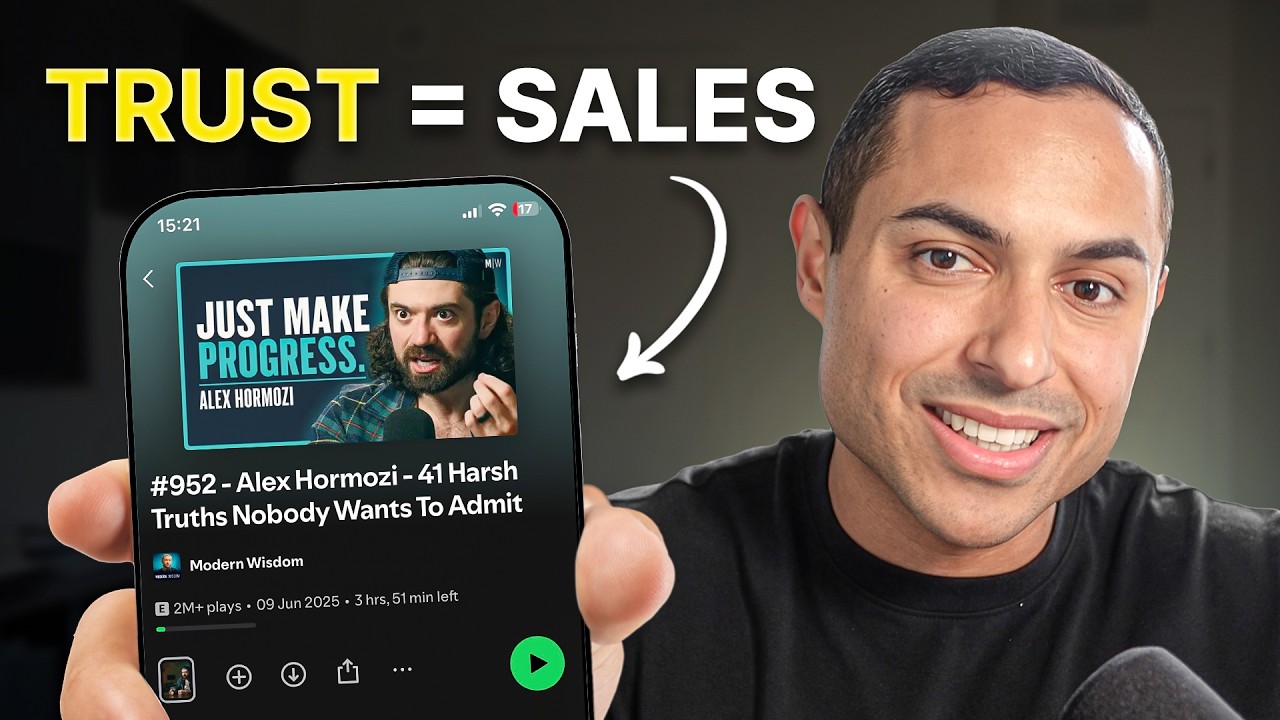
How to Use a Podcast Guest Strategy to Build Psychological Safety and Close More High Ticket Sales
Article Description: Most business owners use a podcast guest strategy for exposure and awareness, but they completely miss the real conversion opportunity. This article breaks down how appearing on podcasts builds the psychological safety that makes high ticket prospects pull the trigger, why trust is spelled T-I-M-E, and how to turn podcast conversations into a subconscious sales mechanism that pre-sells before your sales team ever gets on the phone.
TABLE OF CONTENTS:
Why Most Business Owners Go on Podcasts for Exposure and Miss the Real Revenue Opportunity
How Negative Past Experiences Create Mental Models That Destroy High Ticket Sales Conversions
Why Perceived Risk Is the Hidden Factor Killing Your High Ticket Close Rates
How Psychological Safety Influences High Ticket Prospects to Pull the Trigger
Why Trust Is Spelled T-I-M-E and How Podcast Guest Appearances Maximize It
How Podcast Guest Strategy Gets Prospects to Spend 60 Plus Minutes with Your Brand
Why High Intent Podcast Audiences Convert Better Than Cold Traffic or Paid Ads
How to Turn Podcast Conversations into Subconscious Sales Mechanisms That Pre-Sell
Why Podcast Listeners Show Up to Sales Calls with Higher Certainty and Fewer Objections
How Alex Hormozi Used Podcast Guest Strategy to Build a 106 Million Dollar Launch
Why Your Sales Team Will Thank You for Implementing a Podcast Guest Strategy
How to Compound Trust Across Multiple Podcast Guest Appearances for Maximum Conversion
Why Podcast Guest Strategy Solves the Biggest Conversion Problem in Modern Marketing
OPENING SECTION
A podcast guest strategy is typically viewed as a tool for exposure, brand awareness, or lead generation. And sure, all of those things are true. But what most business owners completely miss is that being a guest on podcasts does something far greater for your business than any of that.
Here's the thing. If you sell something expensive (we're talking $5,000, $10,000, $20,000, or even $100,000 plus), you're operating in a marketplace where trust is at an all-time low. Your prospects have been burned. Multiple times. By people who promised the world and delivered nothing. And that changes everything about how they make buying decisions.
The real power of a podcast guest strategy isn't the downloads or the "exposure." It's the fact that podcasts solve the most foundational problem that exists in today's modern marketplace: the perceived risk your high ticket prospects feel is so high that they can't make a decision. Podcasts fix that. Not in the way you'd expect, but in a way that transforms your entire sales process.
This article breaks down exactly how podcast guest appearances build the psychological safety that makes high ticket prospects convert, why the real currency of trust is time, and how to turn every podcast conversation into a mechanism that pre-sells your offer before your sales team ever picks up the phone.
Why Most Business Owners Go on Podcasts for Exposure and Miss the Real Revenue Opportunity
Most business owners approach a podcast guest strategy with surface-level thinking. They say things like "I want more exposure" or "I need brand awareness" or "I'm looking for leads." And there's nothing wrong with any of that. But it's missing the point entirely.
The real question is: so what?
You get exposure, so that what happens? You get awareness, so that what happens? You get leads, so that what happens? Every time you finish that sentence, the answer is the same: so that you can generate more revenue inside your business. That's why we do any form of marketing in the first place.
But here's where most business owners stop short. They treat podcast appearances like a checkbox. Get on a show. Talk about your expertise. Mention your website. Hope something happens. This approach produces almost zero measurable ROI.
The business owners who actually generate revenue from podcast guest appearances understand something different. They understand that podcasts aren't about getting your name out there. They're about solving a very specific psychological constraint that exists in the minds of your ideal clients. A constraint that, if left unaddressed, will kill your close rates no matter how good your offer is or how skilled your sales team is.
That constraint is the extremely high level of perceived risk that exists in today's marketplace. And podcasts, when used correctly, are one of the most powerful tools for eliminating it.
How Negative Past Experiences Create Mental Models That Destroy High Ticket Sales Conversions
To understand why podcast guest appearances are so powerful for high ticket sales, you first need to understand what's happening in the minds of your ideal clients before they ever enter your sales process.
Your prospects have been burned. Not once. Not twice. Multiple times. They've invested in programs, hired agencies, bought courses, and signed up for services that promised the world and delivered nothing. Every time that happens, they take a hit. And that hit shapes something called a mental model.
A mental model is how someone comes to view the world based on their experiences. It's the lens through which they evaluate every decision going forward. And here's the problem: your ideal client's mental model has been shaped by repeated negative experiences with people who sounded great on the phone or the webinar but didn't deliver on their promises.
So what happens when you, the business owner with a legitimate high ticket offer, come along asking for $10,000 or $20,000? Their mental model gets projected onto you. Subconsciously (and often consciously), they're thinking: "This is going to be like all the other times. They sound good now, but they won't deliver."
You haven't done anything wrong. Your offer might be incredible. Your results might be proven. But none of that matters because you're being evaluated through a mental model that was formed by people who came before you. People who overpromised and underdelivered.
This is the foundational problem that a podcast guest strategy solves. Not by convincing people you're different (because that's what everyone says), but by creating an experience that allows them to come to that conclusion themselves.
Why Perceived Risk Is the Hidden Factor Killing Your High Ticket Close Rates
If you have a sales team, you've probably noticed something in the last few years. Leads feel colder. More people are delaying decisions. "Let me think about it" and "Can I have 24 hours?" have become the default response. One-call closes are getting harder and harder.
The reason isn't your offer. It's perceived risk.
Here's what you need to understand: any investment is a risk. That's just reality. But there's a massive difference between actual risk and perceived risk. Actual risk is the objective probability that something won't work out. Perceived risk is how risky something feels based on your past experiences and current emotional state.
Your prospects aren't evaluating your offer based on actual risk. They're evaluating it based on perceived risk. And their perception has been shaped by all of those negative experiences that formed their mental model. So even if your offer is solid, their perceived risk is through the roof.
This is why traditional marketing tactics are becoming less effective for high ticket offers. Paid ads, cold emails, even webinars. They all trigger a high level of perceived risk because people know what's coming. They know you're going to pitch them. They know it's a "discovery call" that's really a sales call. And based on their past experiences, they project all of that negativity onto your process before you've even had a chance to prove yourself.
The result? Objections. Delays. "I need to talk to my spouse." "Let me run it by my business partner." All of which are symptoms of one thing: the perceived risk is too high for them to feel safe making a decision.
How Psychological Safety Influences High Ticket Prospects to Pull the Trigger
The thing we're really optimizing for in today's marketplace isn't conversion. It's something that comes before conversion. It's psychological safety.
Psychological safety is the feeling your prospects have when they believe it's safe to make a decision. When they feel like they can trust you. When they feel like investing with you isn't going to turn out like all the other times. The more psychologically safe someone feels, the more likely they are to invest.
Think about it. Reflect on your own buying decisions. When you've invested a significant amount of money in something, what made you feel okay about that decision? It wasn't because someone gave you a great pitch. It was because you felt safe. You felt like you could trust the person. You felt like the risk was worth it.
Psychological safety is the opposite of perceived risk. When perceived risk is high, psychological safety is low. When perceived risk is low, psychological safety is high. And the higher someone's psychological safety, the more willing they are to pull the trigger on a high ticket purchase.
So the question becomes: how do you influence people to feel psychologically safe with you, your company, and your offer?
The answer isn't more testimonials. It isn't a better sales script. It isn't overcoming objections. The answer is trust. You need to build a level of trust so deep that they feel safe before they ever get on a sales call. And trust, as we're about to see, comes from one specific place.
Why Trust Is Spelled T-I-M-E and How Podcast Guest Appearances Maximize It
Here's the key concept that changes everything about how you approach a podcast guest strategy.
We don't spell trust T-R-U-S-T. We spell trust T-I-M-E.
The more time you get people to spend with you before you ask them for a dollar, the more they're going to trust you. The more they trust you, the more psychologically safe they feel. And the more psychologically safe they feel, the more likely they are to convert.
This is why podcast guest appearances are so powerful. A single podcast episode gets your ideal client to spend 60 minutes with you. Sixty minutes of hearing your voice. Sixty minutes of understanding how you think. Sixty minutes of seeing how you approach problems. Sixty minutes of experiencing your personality, your values, and your expertise.
Compare that to a 30-second scroll past an ad. Or a 2-minute cold email exchange. Or even a 45-minute webinar where people know you're building to a pitch. None of those come close to the trust-building power of 60 minutes of genuine value delivery on a podcast.
And here's what makes podcast guest strategy even more powerful: there's no perceived risk for the listener. They're not on a sales call. You're not asking them for money. You're just showing up and adding value. So they let their guard down. They actually listen. They actually engage with what you're saying.
The result is trust that's built in a completely different context than traditional marketing. Trust that forms because they've spent significant time with you in an environment that felt safe. That's the trust that converts high ticket offers.
How Podcast Guest Strategy Gets Prospects to Spend 60 Plus Minutes with Your Brand
One podcast guest appearance equals 60 minutes of time spent with your ideal client. But what happens when you appear on two podcasts? Three? Five? Ten?
The time compounds.
Sixty minutes becomes 120 minutes. Then 180. Then 300. Every podcast appearance you make adds to the total amount of time your ideal clients are spending with your brand. And every minute of that time is building trust, reducing perceived risk, and increasing psychological safety.
This is why the most successful thought leaders and business owners don't treat podcast guest appearances as one-off marketing tactics. They treat them as a compounding trust-building machine. The more appearances they make, the more time their audience spends with them, and the higher their conversion rates climb.
Think about the difference between a prospect who found you through a cold email versus a prospect who has listened to you on five different podcasts. The cold email prospect has spent maybe 2 minutes with your brand. They have no trust built. No psychological safety. No context for who you are or how you're different.
The podcast listener has spent 300 minutes with your brand. They know your framework. They've heard your stories. They understand how you think. They've seen how you treat people. They've experienced your expertise firsthand. By the time they book a call, they've already decided you're the person they want to work with.
That's the power of compounding time through a strategic podcast guest strategy.
Why High Intent Podcast Audiences Convert Better Than Cold Traffic or Paid Ads
There's another reason podcast guest appearances produce such high conversion rates for high ticket offers. It comes down to audience intent.
Why do people listen to podcasts in the first place? Because they're looking to solve a specific problem. They're actively searching for information, strategies, and solutions. They're not mindlessly scrolling. They're not half-paying attention while something plays in the background. They're engaged because they want to learn.
This means podcast listeners are high intent by default. They already want what you're talking about. They just don't know your specific solution exists yet.
Compare this to paid advertising where you're interrupting people who weren't thinking about your topic at all. Or cold outreach where you're reaching out to people who didn't ask to hear from you. Those channels require you to create demand from scratch. You have to convince people they have a problem before you can even begin to present your solution.
Podcast audiences are different. The demand already exists. You're not creating demand. You're capturing it. You're presenting your solution to people who are actively looking for exactly what you offer.
When you combine high intent audiences with the trust-building power of 60-minute podcast conversations, you get a recipe for conversion rates that paid ads and cold outreach simply can't match. You're selling to people who are already sold. They just didn't know your solution existed until they heard you on that podcast.
How to Turn Podcast Conversations into Subconscious Sales Mechanisms That Pre-Sell
Being a guest on podcasts isn't just about showing up and talking about your expertise. It's about structuring the conversation so that listeners come to the natural conclusion that they need your offer.
This is what separates business owners who get ROI from podcast guest appearances from those who get nothing but nice conversations and zero leads.
The key is understanding that a podcast conversation can function as a subconscious sales mechanism. From the start of the episode to the end, you're guiding the listener on a journey. You're addressing their problems. You're explaining why those problems exist. You're introducing concepts and frameworks that position your solution as the obvious answer. But you're never "selling" in the traditional sense.
Instead of you trying to convince them, they convince themselves. They hear the problem articulated in a way that resonates deeply. They understand the root cause. They see the solution framework. And by the end of the episode, they've arrived at the conclusion that they need to learn more, that they need to take action, that you're the person who can help them.
This is fundamentally different from traditional sales conversations where the prospect knows they're being pitched and has their guard up the entire time. On a podcast, there's no resistance because there's no perceived sales pressure. They're just listening to valuable content. And that's exactly when persuasion is most effective.
Why Podcast Listeners Show Up to Sales Calls with Higher Certainty and Fewer Objections
Remember the problem we started with? Perceived risk is high. Psychological safety is low. Prospects are delaying decisions and throwing out objections left and right.
Podcast guest strategy flips that entire dynamic.
When someone books a call after listening to you on one or more podcasts, they're not showing up with the same mental state as a cold lead. They've spent time with you. They trust you. They feel psychologically safe. Their perceived risk is dramatically lower because you've already addressed their concerns through content.
This is why podcast-sourced leads close at higher rates than almost any other channel. The sales conversation is completely different. Instead of spending the first 20 minutes trying to build rapport and credibility, you already have both. Instead of fighting through objections about whether you're legitimate or different from everyone else, they already believe you are.
The prospect shows up with certainty. Certainty that you understand their problem. Certainty that you have a solution that works. Certainty that you're the right person to help them.
Certainty is the opposite side of the coin from perceived risk. When certainty is high, objections disappear. When certainty is high, decisions happen fast. When certainty is high, your sales team actually enjoys taking calls because they're talking to people who want to buy, not people who need to be convinced.
How Alex Hormozi Used Podcast Guest Strategy to Build a 106 Million Dollar Launch
If you want proof that this framework actually works at scale, look at Alex Hormozi.
He sold $106 million worth of books and courses in 24 hours. That's not a typo. One hundred and six million dollars in a single day.
How did he do it? Was it a sophisticated ad funnel? A massive affiliate launch? Some secret sales tactic?
Nope. It was trust built through time.
If you study how Alex Hormozi originally built his audience, it was almost entirely through podcast guest appearances. He went on show after show after show. He gave away massive value. He let people spend hours and hours with his content. And by the time he had a product to sell, his audience felt so psychologically safe that they bought without hesitation.
They trusted him. Why? Because they had spent so much time with his brand. They had consumed hundreds of hours of content in a format that felt low-risk and high-value. They came to the natural conclusion that Alex was the person to solve their problems. And when he offered something to buy, the decision was easy.
This is the same dynamic that happens on a smaller scale every time someone listens to you on a podcast and then books a call with your team. The mechanism is identical. Time builds trust. Trust creates psychological safety. Psychological safety produces certainty. And certainty drives conversion.
Why Your Sales Team Will Thank You for Implementing a Podcast Guest Strategy
If you have a sales team, implementing a podcast guest strategy will make their jobs dramatically easier.
Right now, your salespeople are probably fighting an uphill battle on every call. They're dealing with prospects who are skeptical from the jump. Who have their guard up. Who are waiting for the "catch." Who have been burned before and are projecting all of that onto your conversation.
That's exhausting. It leads to burnout. It leads to missed quotas. It leads to a constant cycle of convincing and overcoming objections instead of actually serving people who want to be helped.
Now imagine what happens when your leads come in pre-sold. When they've already spent hours consuming your podcast content. When they already trust you and feel psychologically safe. When they show up to the call with certainty instead of skepticism.
Your sales team goes from convincing to simply clarifying. From fighting objections to answering questions. From pushing people to pull the trigger to simply processing decisions that have already been made.
The close rate goes up. The average deal size goes up. The sales cycle gets shorter. And your team actually enjoys their job because they're talking to people who want to buy.
That's what a strategic podcast guest approach does for your sales process.
How to Compound Trust Across Multiple Podcast Guest Appearances for Maximum Conversion
The real power of podcast guest strategy comes from consistency over time.
One podcast appearance is powerful. But multiple podcast appearances compound exponentially. Every show you go on adds to the total time your ideal clients spend with your brand. Every conversation reinforces your expertise, your frameworks, and your positioning.
Here's how to think about it strategically:
If you appear on one podcast per month for a year, that's 12 episodes. At 60 minutes per episode, that's 720 minutes of trust-building content. Twelve hours of your ideal clients experiencing your value, your expertise, and your personality in a low-risk environment.
Now imagine those 12 episodes are on shows where your ideal clients actually listen. Shows in your specific industry. Shows with audiences who are actively looking for solutions like yours. Every minute of that content is working for you, building trust with the exact people who could become high ticket clients.
The compounding effect is massive. Somebody who discovers you through one podcast might go back and listen to three more. Then they see you on another show and listen to that one too. By the time they book a call, they've spent 5+ hours with your brand. They know you. They trust you. They're ready to buy.
This is why the most successful business owners treat podcast guest strategy as an ongoing investment, not a one-time tactic.
Why Podcast Guest Strategy Solves the Biggest Conversion Problem in Modern Marketing
Let's bring this full circle.
The biggest problem in today's marketplace isn't lead generation. It's not traffic. It's not even offer quality. The biggest problem is that your ideal clients have such high perceived risk and such low psychological safety that they can't make decisions.
They've been burned too many times. Their mental model has been shaped by negative experiences. Every investment they consider gets filtered through that lens of "this is probably going to turn out like all the other times."
Traditional marketing can't solve this problem. Ads trigger perceived risk because people know a pitch is coming. Cold outreach triggers perceived risk because it's unsolicited. Even webinars trigger perceived risk because the sales mechanism is obvious.
But podcast guest appearances? They're different.
There's no pitch pressure. There's no immediate ask. There's just value delivered over an extended period of time in a format that feels safe and genuine. And that's exactly the environment where trust gets built and perceived risk gets dismantled.
When you invest in a strategic podcast guest approach, you're not just getting exposure or leads. You're directly addressing the foundational constraint that makes high ticket sales difficult in the first place. You're building the psychological safety that makes people feel certain enough to invest.
If you sell something that costs $5,000, $10,000, $20,000, or more, this isn't optional. It's the thing that makes everything else work. It's the missing piece that turns "I need to think about it" into "Where do I sign?"
Podcast guest strategy isn't a nice-to-have. It's the foundation of high ticket conversion in today's trust-depleted marketplace.