
How to Convert Podcast Listeners Into Clients Using the Contrast Principle
Article Description: Most people go on podcast appearances, have a great conversation, and walk away with zero clients. Here's the exact psychological trigger that turns listeners into buyers, including how one client added $80-100K per month in recurring revenue and another made $63K from a single appearance.
Table of Contents:
Why Podcast Guest Appearances Generate Exposure But Zero Clients
What the Contrast Principle Is and Why It Changes Everything
Why People Only Buy From the Person Who Makes Them Feel Most Understood
The Good Guys Bad Guys Framework for Answering Podcast Host Questions
Psychological Trigger #1: Getting Listeners to Understand Why Past Attempts Failed
Psychological Trigger #2: How to Stick the Knife In and Twist It
Psychological Trigger #3: How to Cure Possibility Blindness in Your Audience
Psychological Trigger #4: How to Position Your Offer as the Only Logical Solution
How to Apply Contrast to Any Question a Podcast Host Asks You
Why You Must Acknowledge Both Sides When Calling Out What Doesn't Work
How to Verbalize What Your Listeners Internalize to Build Instant Trust
How to Use the End Result Framework to Make Your Solution Feel Inevitable
Why Contrast Eliminates Comparison Bias Before Prospects Even Get on a Sales Call
Most people treat podcast guest appearances like a PR play. Show up, be charming, drop some value, mention the website, and hope that somehow turns into clients.
It doesn't. And it's not because podcasts don't work. It's because they're missing the one psychological trigger that separates guests who generate revenue from guests who generate nothing but a nice audio clip to post on LinkedIn.
That trigger is contrast. And once you understand how to use it, your podcast appearances stop being content and start being a conversion system.
Our client Jason added $80-100K per month in recurring revenue from the podcasts we booked him on. Heather made $63K from her very first appearance. The difference between them and everyone else who walks away with zero? They understood contrast at a deep level and deployed it every single time.
Here's the full breakdown.
Why Podcast Guest Appearances Generate Exposure But Zero Clients
Podcast guest appearances fail to generate clients for one reason: guests focus entirely on communicating their story instead of making the audience feel understood.
The typical podcast appearance goes like this. The host asks questions. The guest answers them with charisma. They talk about their methodology, their results, their journey. They tell everyone how great their process is and drop a link at the end. Applause. Downloads. Zero clients.
Here's what's actually happening in the listener's brain during that appearance. They're processing information. They might find it interesting. But at no point do they feel like this person gets them, specifically. At no point do they experience the emotional recognition that triggers buying behavior.
The exposure that comes from podcast interviews is completely worthless if it never converts into trust. And trust doesn't come from you explaining your process. It comes from you demonstrating that you understand their specific situation better than they do.
That's the gap. And contrast is what closes it.
What the Contrast Principle Is and Why It Changes Everything
The contrast principle is the practice of simultaneously explaining why everything a listener has tried in the past hasn't worked and what the thing that actually works looks like.
Most podcast guests do half the equation. They show up and tell you what to do. The right strategy, the right framework, the right approach. They focus entirely on the good guys side of the story.
What they skip is the bad guys side. And that skip is costing them every client they could have had.
When you apply contrast properly, every answer you give a podcast host has two parts. Part one: here's what most people try, why it seems logical, the real reasons it doesn't work, and the specific negative consequences it creates in their life. Part two: here's what actually works, why it works, the positive outcomes that come from it, and how it helps them get to the result they actually want.
This isn't just a communication tactic. It's a reflection of a fundamental universal law. For every up there's a down. Every coin has two sides. Every left has a right. People cannot understand what good looks like until they first understand what bad looks like.
Think about a steak. If you grew up eating tough, flavorless London broil out of the oven, you thought that was a great steak. Until the first time you had A5 Wagyu. The contrast between the two is what gave you the context to understand quality.
Your podcast listeners are sitting there eating London broil and thinking it's fine. Your job is to show them what Wagyu tastes like, and you can only do that by first acknowledging exactly what London broil is and why it's been disappointing them.
Why People Only Buy From the Person Who Makes Them Feel Most Understood
The number one buying trigger isn't your results, your credentials, or your methodology. It's the feeling of being understood by another human being.
Most podcast guests spend their entire appearance trying to get the audience to understand them. Their story. Their process. Their wins. Their approach.
That's completely backwards.
The guests who convert listeners into clients spend their time trying to get the audience to understand that they are understood. There's a massive difference between those two things, and that difference is measured in dollars.
When a listener hears you describe a situation they've experienced, using language that matches how they experience it internally, something shifts in their brain. They stop being a passive listener and they start being an active believer. They think: this person gets it. This person gets me.
That shift is what creates the desire to take action. Not the information. Not the methodology. Not the testimonials. The feeling of being understood at a level that very few people have ever understood them.
Contrast is the delivery mechanism for that feeling. When you accurately describe the things they've tried and explain exactly why those things haven't worked, you're not just educating them. You're mirroring their internal experience back to them in a way that creates an almost magnetic connection.
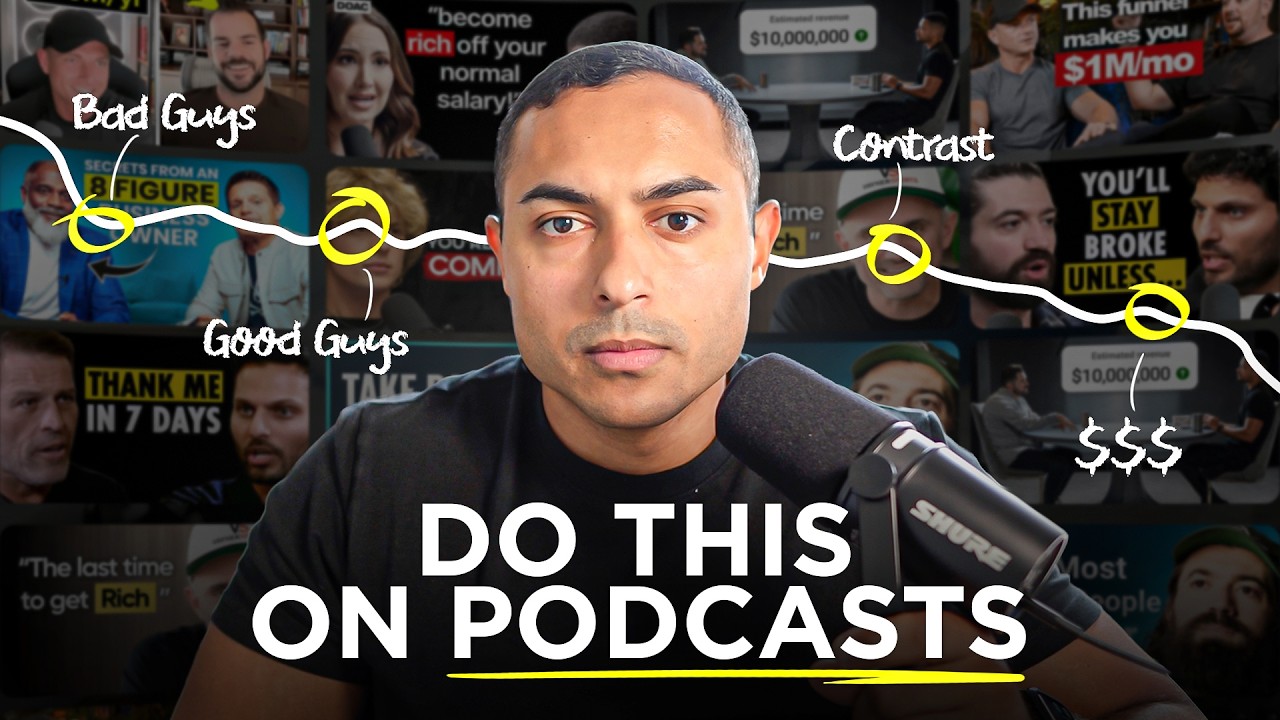
The Good Guys Bad Guys Framework for Answering Podcast Host Questions
Every question a podcast host asks you is an opportunity to run the contrast principle. The simplest way to do that is to think in terms of good guys and bad guys.
Bad guys: what most people do, why it seems to make sense, the real reasons it doesn't work, and the painful consequences it creates.
Good guys: what actually works, why it works, the positive outcomes it produces, and how it helps them achieve the end result they're after.
Before you answer any question on a podcast, run it through this filter first. What do most people try when it comes to this topic? What's the common approach that sounds reasonable but fails? What are the real consequences of that failure? Only after you've established all of that do you transition to what you actually recommend.
Here's the language pattern that makes this seamless: "Before I tell you what we do to get our clients results, let me first describe what most people try when it comes to this."
That one sentence does three things. It signals to the listener that you're aware of the landscape. It sets up the contrast. And it makes everything you say next land with significantly more weight because the audience now has a reference point for what doesn't work.
Think of it like this: you're not just answering the host's question. You're giving every listener a simultaneous explanation of why they've struggled in the past and why your approach is the logical solution. That's what turns a podcast appearance into a client acquisition event.
Psychological Trigger #1: Getting Listeners to Understand Why Past Attempts Failed
The first reason contrast works so powerfully is that it gets people to go somewhere they rarely go by themselves: a genuine understanding of why the things they've tried haven't worked.
Most people who've failed at something repeatedly don't do a thorough post-mortem. They just conclude "I guess this doesn't work" or, worse, "I guess I'm not capable of making it work." They don't examine the specific reasons their attempts failed because that kind of reflection is uncomfortable.
When you come along and give them that analysis, you're doing something nobody else has done for them. You're not just pointing out what was wrong. You're giving them the context they needed to make sense of their own experience.
This produces an epiphany moment. That sudden shift where someone goes from "I guess it just doesn't work" to "Oh. That's exactly why it didn't work." And that shift matters enormously because it moves them from hopelessness to possibility.
The practical implication for your podcast guest strategy is this. When a prospect gets on a sales call with you and says "I've tried things like this before and they didn't work," the contrast you applied on the podcast has already pre-handled that objection. They understand why the past things didn't work. So the fear that your thing will also fail is significantly reduced.
Contrast doesn't just build trust. It eliminates the objections that would otherwise kill deals before they even start.
Psychological Trigger #2: How to Stick the Knife In and Twist It
The second psychological reason contrast works is that it forces listeners to actually feel the weight of the consequences they've been living with, not just acknowledge them intellectually.
There's a significant difference between saying "most people try cold outreach and it doesn't work very well" and actually describing the emotional and practical reality of what that failure looks like in someone's daily life.
The first version is information. The listener processes it and moves on.
The second version is an experience. The listener recognizes themselves in it.
Here's what "sticking the knife in and twisting it" looks like in practice. Instead of saying "cold outreach doesn't convert well," you describe the specific reality: you're spending hours sending messages that end up in a request folder that nobody checks. Your response rate is embarrassingly low. You've built a team around this strategy, you're paying them every month, and the math still doesn't work. And every morning you're asking yourself whether this is actually a viable path or whether you're just too stubborn to admit it isn't.
That description makes people feel the consequence, not just understand it intellectually. And when they feel it, two things happen. First, they recognize their own version of that scenario. Second, they become significantly more motivated to find a solution.
This is where many podcast guests pull their punch. They describe the problem in vague terms because they don't want to seem negative or pushy. But vague problems don't create urgency. Specific, vivid, emotionally resonant descriptions of real consequences are what make people genuinely ready to change.
The key is that you're not describing a problem for the sake of negativity. You're describing it so the listener can say "yes, that's exactly what's been happening to me." That recognition is the bridge to everything that comes next.
Psychological Trigger #3: How to Cure Possibility Blindness in Your Audience
The third psychological reason contrast works is that it opens people up to possibilities they've closed themselves off from, which is what you might call possibility blindness.
Possibility blindness happens when someone has tried enough things that haven't worked that they stop believing a solution exists. They're not necessarily pessimistic people. They've just been burned enough times that their brain has started protecting them from further disappointment by shutting down hope.
This is one of the most common psychological states your ideal clients are in when they're listening to podcasts. They're consuming content, learning things, even getting excited about ideas. But underneath all of that there's a quiet voice saying: "I've heard versions of this before and it never actually worked."
The contrast principle is the most effective antidote to possibility blindness that exists.
Here's why. When you accurately describe the things they've tried and explain precisely why those things failed, you're not just validating their experience. You're reframing their history. Instead of "I tried things and failed," the narrative becomes "I tried specific things that had specific flaws, which is why they produced specific failures." That reframe is huge.
Because if the failure was specific and explainable, then the possibility of a different outcome is real. The failure wasn't about them. It was about the vehicle they were using. Change the vehicle and the result changes.
This is exactly the point where you transition from the bad guys half of the contrast to the good guys half. The listener has now been primed by three things: they understand what they've been doing wrong, they've felt the weight of those consequences, and they've been opened up to the possibility that a different approach could actually work. Now you tell them what that approach is.
Psychological Trigger #4: How to Position Your Offer as the Only Logical Solution
The fourth and final psychological trigger that contrast activates is the positioning of your solution as the natural, inevitable answer to everything the listener has just processed.
This is where contrast pays off completely. After walking a listener through the bad guys side, after making them feel the consequences, after opening them up to possibility, you transition to your recommendation. And because of the groundwork you've laid, that recommendation lands differently than it would have if you'd just led with it at the start.
It doesn't feel like a pitch. It feels like the logical conclusion to an honest analysis.
The important thing here is how you make this transition. You're not saying "and that's why you need to work with me." That comes across as the sales moment that listeners mentally check out for. What you're saying is "here's what I've found actually works when it comes to this." You're positioned as a guide who's sharing what they've discovered, not a salesperson trying to close a deal.
Your solution, your methodology, the thing you sell, just happens to be the embodiment of the better way. But you never have to say that explicitly. The contrast has already made it obvious.
By the end of a 45 to 60 minute podcast appearance built on contrast, the listener has arrived at your solution through their own logical process. You didn't push them there. You led them there. And people who feel like they arrived at a conclusion themselves are significantly more committed to acting on it than people who were sold on it.
How to Apply Contrast to Any Question a Podcast Host Asks You
The practical application of contrast is simpler than most people think. You just need a consistent mental framework for running every host question through before you answer it.
Step one: hear the question.
Step two: ask yourself, what do most people do, try, or believe when it comes to this topic?
Step three: identify the positive aspects of that common approach (because there usually are some).
Step four: identify the real reasons that common approach fails and the specific consequences it creates.
Step five: transition to what actually works and why, framing it as your recommendation, not a sales pitch.
Step six: connect your recommendation to the end result the listener wants.
Here's a concrete example. The host asks: "What's the most effective way to generate leads for a high-ticket service business?"
Wrong approach: "Great question. At our company we use a multi-channel approach that includes podcast appearances, content marketing, and a pre-selling funnel. Here are the results we get for clients..."
Contrast approach: "Before I tell you what we've found actually works, let me speak to the person listening who's probably already tried a few things. The first thing most people try is cold outreach, and that approach actually has some real merit because it's targeted and costs almost nothing. But the problem is that cold outreach is basically invisible now. Messages end up in request folders that nobody checks. And even when they do get through, you're interrupting someone who didn't ask to hear from you, which makes the conversion rate brutal. Then a lot of people move to paid ads, which can hypothetically work very fast. The issue is that before ads scale, they have to work slowly, and that slow phase requires a budget that most people underestimate. So they spend a few hundred dollars, don't see results, and conclude that ads don't work for their business. But they never had the budget to get through the validation phase in the first place. What we've found actually works for high-ticket service businesses is podcast guest appearances, and here's specifically why..."
You see the difference. One is information. The other is a conversion event.
Why You Must Acknowledge Both Sides When Calling Out What Doesn't Work
One of the most important nuances of the contrast principle is that you cannot just bash everything the listener has tried. You have to acknowledge what's legitimately good about those approaches before you explain why they fail.
This came from Myron Golden, a mentor who pointed out a simple truth: if you only talk about what's bad about the common approaches, people won't believe you. Because they know there are two sides to every coin. When someone only shows you one side, your brain instinctively suspects the other side is being hidden.
The moment you acknowledge the genuine positives of an approach before explaining its limitations, your credibility triples. Because now you're not attacking the thing they tried. You're giving an honest analysis. And honest analysis builds the kind of trust that converts.
Here's how this works in practice. Instead of "cold outreach doesn't work," you say: "Cold outreach is actually a solid approach in some ways. It's free, it's highly targeted, and done right it can be very effective. The challenge is that the landscape has changed. DMs end up in folders that never get checked. Response rates have tanked. And scaling it requires building a team, which changes the economics fast."
Now you've done two things. You've validated the intelligence of the people who tried that approach (because it does have real merit). And you've given them a legitimate reason why it didn't work for them that has nothing to do with their capability or intelligence.
That combination is what makes the listener trust you. They're not being told they were stupid for trying something. They're being told the deck was stacked against them in specific, identifiable ways. That's a completely different emotional experience.
How to Verbalize What Your Listeners Internalize to Build Instant Trust
One of the most powerful things you can do on a podcast guest appearance is say out loud the things your listeners hold privately inside themselves and would never tell anyone.
This is the deepest level of the contrast principle. It's not just describing the consequences of what hasn't worked. It's describing the internal emotional experience that goes along with those consequences, the thoughts and feelings that people have but keep private because they're too vulnerable or too embarrassing to share.
Here's an example. Most people who are struggling with their business don't admit to friends or family how bad it actually feels. If a friend asks "how's business going?" they say "great, really building momentum." But internally they're thinking: how much longer can I keep this up? Am I actually capable of making this work? What if I'm just not the person who gets to have this?
When you articulate those hidden thoughts on a podcast, something profound happens. The listener experiences a kind of relief. Someone finally said the thing they thought only they were thinking. That experience creates an almost instant bond, because the person who puts words to your private experience feels like an ally, a person who's safe and who genuinely understands.
The practical application is to go beyond describing what someone tries and fails at and to describe what they say to themselves about it. You probably told everyone things were going great. But in the back of your head you knew it wasn't sustainable. You knew the math wasn't working. And every morning when you woke up, there was that quiet awareness that something needed to change.
That's the line that makes a listener put down their phone, turn up the volume, and think: this person is talking directly to me.
That's the feeling that converts podcast listeners into clients.
How to Use the End Result Framework to Make Your Solution Feel Inevitable
Every element of contrast you use on a podcast should be anchored to the listener's end result, the ultimate outcome they want but haven't been able to achieve.
The contrast principle isn't just about comparing approaches. It's about showing how one path moves someone farther from their end result while another path moves them closer to it. When you frame everything through that lens, your solution doesn't just sound better. It sounds inevitable.
Here's the structure. For the bad guys side: here's what most people do, here's why it fails, and here's how that failure pushes them farther from the end result they actually want.
For the good guys side: here's what actually works, here's why it works, and here's how it pulls them closer to the end result they've been chasing.
This framing matters because it keeps the listener's desire activated throughout your entire answer. They're not just processing information about strategies. They're experiencing the gap between where they are and where they want to be, and they're watching you close that gap in real time.
The end result for your listener might be consistent high-quality leads. Or a business that runs without them. Or revenue that's actually predictable. Whatever it is, every piece of contrast you use should either move them farther from it (the bad guys) or closer to it (the good guys).
When you do this consistently across an entire podcast appearance, the listener arrives at the end of the episode having experienced a complete journey. From confusion about why things haven't worked, to clarity about the specific reasons, to openness about the possibility of a better way, to belief that your approach is the vehicle that will get them there.
That's not a podcast listener anymore. That's a pre-sold prospect.
Why Contrast Eliminates Comparison Bias Before Prospects Even Get on a Sales Call
One of the most underrated benefits of the contrast principle is that it pre-handles the single most common sales objection before your prospect ever gets on a call with you: "I've tried things like this before and they didn't work."
Comparison bias is what happens when a prospect hears about your solution and immediately maps it onto everything they've already tried. They think: this sounds like the coaching program I bought two years ago. Sounds like the agency I hired that delivered nothing. Sounds like the course that was full of theory and light on results.
If you haven't done the work of contrast on a podcast, that bias sits there fully intact when they get on a sales call. Your sales team has to fight through it. And fighting through entrenched comparison bias is one of the hardest things in sales.
But when you apply contrast during your podcast guest appearance, you've already surgically separated your approach from everything they've tried before. You've named what they've tried. You've explained exactly why it failed. And you've shown them specifically how what you do is different at a mechanistic level.
By the time they book a call, the comparison bias has largely dissolved. Not because you promised better results, but because you demonstrated a genuine understanding of why the old things didn't work and gave them a clear logical framework for why your approach is genuinely different.
That's the power of building your entire podcast guest strategy around contrast. You're not just getting exposure. You're doing the selling before the sales call even happens. By the time someone from your audience books a time with your team, they've already pre-sold themselves on the idea that you're different, that your approach is different, and that the outcome could actually be different this time.
That's how Jason hit $80-100K per month. That's how Heather turned one appearance into $63K. And that's how contrast, applied consistently across your podcast appearances, turns a content strategy into a client acquisition machine.