
How to Create Podcast Talking Points That Convert Using the 4 Quadrants of Content Framework
Article Description: Most people create podcast talking points based on what they want to say, not what their audience needs to hear. Here's the exact framework that transforms podcast appearances into sales assets by addressing your prospects' questions, beliefs, objections, and expectations before they ever enter your sales process.
TABLE OF CONTENTS:
Why Most Podcast Talking Points Generate Zero Sales and What to Do Instead
The Round Table Framework: How to Stop Talking to Just the Host on Podcasts
How to Extract Podcast Talking Points from Your Sales Call Data Using AI
The 4 Quadrants of Content Framework for High-Converting Podcast Appearances
Quadrant 1: How to Answer Prospect Questions Through Podcast Content
Quadrant 2: How to Shift False Beliefs and Myths on Podcasts to Pre-Frame Buyers
Quadrant 3: How to Overcome Objections Through Podcast Storytelling
The Embedded Commands Technique: Using Stories to Handle Price Objections
Quadrant 4: How to Set Proper Expectations on Podcasts to Attract Ideal Clients
How to Use Podcasts as Sales Assets in Your Marketing and Sales Process
Why Converting Podcast Listeners Is Your Moral Responsibility as a Business Owner
OPENING SECTION:
Podcast talking points are the difference between walking away with a handful of new followers and walking away with a pipeline full of pre-sold prospects ready to buy. Most people completely butcher this.
Here's what typically happens: Someone goes on a podcast, has a great conversation with the host, shares their story, answers some questions, and then... nothing. No leads. No calls booked. No revenue. And the worst part? They have zero attribution to know if it even worked.
The problem isn't that podcasts don't work. The problem is that most people's podcast guest content strategy is completely backwards. They show up and talk about what they want to say instead of what their ideal clients need to hear in order to move further along the buying journey.
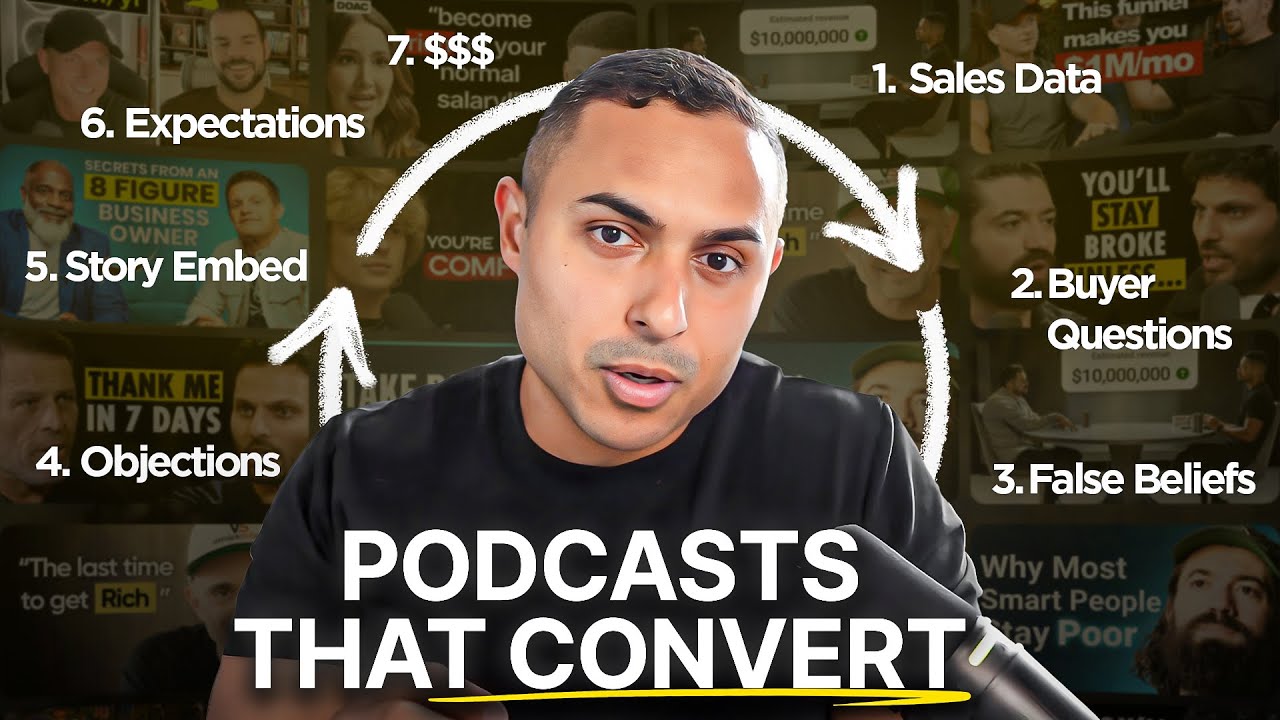
That's where the 4 Quadrants of Content framework comes in. This approach transforms your podcast appearances from random conversations into strategic sales assets that answer questions, shift beliefs, overcome objections, and set proper expectations, all before your prospects ever enter your sales process.
Why Most Podcast Talking Points Generate Zero Sales and What to Do Instead
Most people lose the belief that podcasts could work for them because they've tried it and gotten no results. They'll tell you, "I went on a bunch of podcasts and I don't even know if they worked." And they're right, they probably didn't work. But it's not the vehicle that's broken. It's the podcast conversion strategy behind it.
Here's the reality: Podcasts don't make you money. The content you share on podcasts, specifically your talking points, makes you money. If you show up and just tell your story and answer whatever questions the host throws at you, you're leaving massive amounts of revenue on the table.
The fix is simple but requires a complete shift in how you approach being a guest. You need to understand that your number one goal on these podcasts is to influence the thoughts, feelings, and beliefs of your ideal client. That's it. Everything else is secondary.
When you look at podcast appearances this way, suddenly the talking points you prepare become strategic weapons instead of random conversation topics. And that's when podcast guesting starts generating real revenue.
The Round Table Framework: How to Stop Talking to Just the Host on Podcasts
Before diving into the 4 Quadrants, you need to understand a fundamental shift in how to approach podcast guest appearances. Picture three people sitting at a round table: you, the host, and the audience.
What most people do is talk exclusively to the host. The host asks a question, they answer it. The host asks another question, they answer that one too. Back and forth, back and forth. They completely ignore that there's someone on the receiving end of that message: the listener.
The host is simply the conduit and facilitator between you and your ideal client who's tuning into that podcast. Your job is to master the art of transforming the listeners, both individually and collectively. That means you need to be able to articulate your message in a way where you're reaching the audience while getting the host to follow your lead.
When you nail this, something powerful happens. The next question the host asks becomes the question you wanted them to ask because your answer naturally led there. You're in control of the conversation while still making it feel organic and valuable to everyone listening.
How to Extract Podcast Talking Points from Your Sales Call Data Using AI
Here's where most people go wrong with podcast content strategy: they come up with talking points based on what they think is interesting or what they want to share. Wrong approach entirely.
Your audience and prospects should give you the content. You don't come up with it yourself. Sure, you'll craft the stories and articulate the points, but the actual talking points should come directly from your sales process data.
Here's exactly how to do this: Have your sales team pull up the last 100 sales calls. Load them into an AI tool like Claude. Then extract the following information:
First, identify the most common reasons why people aren't buying. What objections keep coming up?
Second, find the most frequently asked questions. What do prospects consistently want to know?
Third, discover what expectations people have when they show up on these calls. Are they expecting a quick fix? Long-term results?
Fourth, uncover what beliefs people hold that aren't actually true. What myths are keeping them stuck?
If you're not already recording your sales calls, get a tool like Fathom.ai set up immediately. This sales call data becomes the foundation for every piece of podcast content you create.
Bonus tip: Also look at how well-framed people show up to your sales calls. Are they ready to make a buying decision, or do they just show up to be educated? This gives you a baseline to measure the effectiveness of your podcasts once you start deploying them strategically.
The 4 Quadrants of Content Framework for High-Converting Podcast Appearances
Now that you understand where your podcast talking points should come from, let's break down exactly how to structure them. The 4 Quadrants of Content framework gives you a systematic approach to creating podcast content that moves prospects further along their buying journey.
The four quadrants are: Questions, Myths and False Beliefs, Objections, and Expectations.
Each quadrant serves a specific purpose in the pre-framing process. When you address all four on your podcast appearances, prospects show up to your sales calls already educated, already trusting you, and already convinced you're the right solution. Let's break down each one.
Quadrant 1: How to Answer Prospect Questions Through Podcast Content
The first quadrant focuses on questions your ideal clients currently have that, if left unanswered, will stop them from buying or at least lower the chances of them buying. This is where your sales call data becomes invaluable.
Go back to those 100 sales calls you analyzed. What are the five most frequently asked questions your prospects have? These questions could be about your process, your results, your pricing structure, the timeline, or anything else that consistently comes up.
Now, here's the strategic play: What if you could go on a podcast and, through how you articulate your message and stories, answer all of those questions for your prospects before they ever enter your sales conversation?
When people show up to sales calls more educated, they're more likely to buy. The more educated they are, the more they trust you. So your job in Quadrant 1 is to identify those frequently asked questions and craft talking points that provide the answers naturally through your podcast content.
Important note: This doesn't mean going on a podcast and saying, "A question my clients ask me all the time is..." There's an art and science to weaving these answers into your stories and examples without being obvious about it. The answers should flow naturally from your content.
Quadrant 2: How to Shift False Beliefs and Myths on Podcasts to Pre-Frame Buyers
The second quadrant addresses the myths and false beliefs your ideal client currently holds about achieving the dream outcome you help them achieve. These false beliefs are what's currently keeping them stuck.
Here's an example: Let's say you help people lose weight. A big myth might be that someone has to eat 1,200 calories a day in order to lose weight. If your prospect believes this, they might think your program won't work for them because they can't sustain such a restrictive diet.
So when you're on a podcast, you address it directly: "One of the biggest mistakes I see is people thinking they have to eat 1,200 calories a day to lose weight. In fact, that couldn't be further from the truth." Now you're shifting that person's belief through the podcast content.
The psychological principle at work here is powerful. When you articulate their false belief and then demonstrate that you deeply understand where they're coming from, you become the bridge between their old belief and the new belief they need to hold. They used to think they needed to eat 1,200 calories. Now they understand they can eat 2,000 calories. The only difference is the strategy. And guess who holds that strategy? You.
Go through your sales data and identify what false beliefs your prospects consistently hold. Then craft podcast talking points that meet them where they are and guide them to the new belief.
Quadrant 3: How to Overcome Objections Through Podcast Storytelling
The third quadrant is all about objection handling through podcast content. Look at the most frequent objections your sales team encounters. Is it price? Timing? Something personal like not believing it's possible for them specifically?
Here's a principle that changed everything for me: The number one way to overcome an objection is to give it to them before they ever knew they had it. I learned this at a $5,000 two-day event when I was 20 years old and had to put it on a 34% interest credit card. Best investment I ever made.
When you address objections on a podcast before your prospect even realizes they would have had that objection, you shift their belief subconsciously. They won't ever raise that objection on the sales call because you've already handled it.
You have two options with objections. Option one: Have your sales team address it once the prospect drops it on the call, which is never the most fun experience. Option two: Be proactive and overcome that objection through your podcast content without the person even realizing it happened.
The most powerful way to do this? Storytelling with embedded commands.
The Embedded Commands Technique: Using Stories to Handle Price Objections
Let me show you exactly how embedded commands in storytelling work for handling the most common objection: price. This technique allows you to overcome the "it's too expensive" objection before your prospect ever sits down on a sales call.
Here's a story you could tell on a podcast: "Back in 2021, I went on an app called Clubhouse. It was an audio-based app where you could join rooms and discuss different topics. I joined a room about storytelling, and the host was my childhood hero, Les Brown. I couldn't believe I was there."
"Les started talking about a new program called Hungry to Speak where he'd teach storytelling, getting on stages, and getting paid to speak. My goal was to be a motivational speaker, so I was getting excited. But the one question I kept asking myself was: How much is it?"
Notice what's happening here. Your ideal clients have that same question in the back of their head during every sales call. By embedding it in your story, the listener starts mirroring your experience with their own.
"Finally, he got to the price: $297 a month. I had no idea how I was going to afford that. I had just bought a house, just bought a car. I was 21 years old and had no money."
Now the listener is thinking about their own financial situation and all the reasons they might not be able to afford your solution. They're living vicariously through your story.
"I called my dad and said I really wanted to join but couldn't afford it. And he said three words that changed my life: 'Figure it out.' So I took out that credit card with 34% interest, asked myself if my goals and dreams were worth it, and made the decision. It ended up being the greatest decision of my life."
That phrase, "figure it out," spoken with the right tonality, is an embedded command. You're programming your prospects to have that same mentality when faced with a financial decision they know will transform their business.
Will this eliminate the price objection for everyone? No. But if 20% fewer people give you that objection and 20% more start buying, that moves the needle significantly.
Quadrant 4: How to Set Proper Expectations on Podcasts to Attract Ideal Clients
The fourth quadrant addresses expectations: What are the proper expectations people need to have about what success looks like with whatever you help them achieve? And what are the proper expectations if they wanted to work with you specifically?
Here's an example from my business. We get people booked on podcasts and show them how to monetize those appearances. One expectation I need prospects to have is that this is a long-term game. You can't come in during the first 30-60-90 days and expect a bunch of clients because the timeline includes scheduling podcasts, recording them, editing, queuing, and releasing. It takes time.
So when I'm on a podcast, I set that expectation directly: "One thing I need people to understand about podcast guesting, whether you work with us, another company, or do it yourself, don't expect a financial ROI in the first 90 days because of X, Y, and Z reasons."
When you set expectations through podcast content, prospects come into sales conversations already in that frame of mind. They arrive with realistic expectations rather than their own assumptions, which is when you lose deals. You can't bridge the gap between what someone expects and what's actually realistic if you haven't set those expectations upfront.
Other expectation topics to address: How long does it typically take? What are average returns? How much effort will they need to put in? These should all come from your onboarding process and sales data.
Here's a bonus effect: Setting proper expectations immediately pushes away everyone who wants a quick fix or overnight results, the people you don't want as clients anyway. Simultaneously, you attract the people who understand the real game and are willing to commit.
How to Use Podcasts as Sales Assets in Your Marketing and Sales Process
Once you've created podcast content using the 4 Quadrants framework, the next step is deploying those episodes strategically. This is where podcasts transform from marketing exposure into genuine sales assets.
If you have a sales team, leverage these podcast episodes as what we call trust assets. Have your sales team send these podcasts to prospects before the call. The prospect shows up already having the answers to questions they would have asked, already with their false beliefs shifted, already with common objections handled, and already with realistic expectations set.
The result: People show up to sales calls significantly more educated and more framed. They're not there to be sold. They're there because they've already decided you're likely the right fit and just need confirmation.
You can also deploy this podcast content through your paid advertising, cold email sequences, organic social, and anywhere else prospects might encounter you. The key is consistency: making sure the same core messages show up everywhere so prospects build trust through repeated exposure to your framework.
Once you start measuring the before and after, you'll notice how much better framed people are showing up. That's when you know the 4 Quadrants of Content framework is working.
Why Converting Podcast Listeners Is Your Moral Responsibility as a Business Owner
Here's something important about podcast conversion strategy that goes beyond just making more money. What you do, if you're reading this, is incredibly valuable. You need to do everything in your ability to make sure you get people to take the desired action because you know that working with you is a decision they will never regret.
Someone told me this once when I was hesitant about selling: "If you don't convert them, someone else who cares half as much about your clients as you do, who just wants the money, who won't take care of them, will."
That hit me hard. Because here's the truth: if you don't get that prospect over the line, they're going to find someone else. And that someone else might be doing it for the wrong reasons. That person is going to get hurt, and you could have prevented it.
So use these four quadrants. Answer their questions. Shift their false beliefs. Overcome their objections before they have them. Set proper expectations. And when you incorporate podcasts into your organic marketing, paid advertising, and sales process with this framework, I guarantee you'll see a tremendous difference in how educated, how framed, and ultimately how ready to buy your prospects show up.
Your people deserve it.